
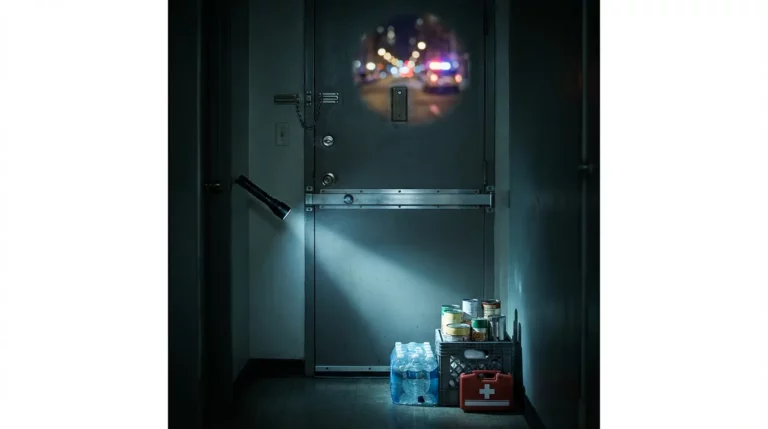
During civil unrest, power outages, or rapid urban deterioration, your apartment is your best defensive position — but most apartments have serious security gaps that take under an hour to close. Door frames that splinter on the first kick. Ground-floor windows with no reinforcement. No supplies for 72 hours without leaving. This guide covers every layer, in priority order, for renters who can’t install permanent hardware.
Table of Contents
- Step 1 — Assess Your Apartment’s Real Vulnerabilities
- Step 2 — Harden Your Doors (The #1 Priority)
- Step 3 — Secure Your Windows
- Step 4 — Situational Awareness During Chaos
- Step 5 — Build Your 72-Hour Shelter-in-Place Kit
- Step 6 — Communication When Networks Go Down
- Step 7 — Stay or Go? How to Decide
- Common Mistakes
- FAQ
Step 1 — Assess Your Apartment’s Real Vulnerabilities
Most apartment break-ins happen through the front door — not the window, not the back, the front door. The lock is rarely the failure point. The frame and strike plate are. A standard residential strike plate is held by ½” screws into soft wood. It fails on the first forceful kick.
Walk through your apartment and answer these questions:
| Vulnerability | Risk level | Fix time | Fix cost |
|---|---|---|---|
| Front door — no security bar or barricade | High | 5 min | $25–$40 |
| Strike plate with short screws (under 3″) | High | 15 min | $15–$25 |
| Sliding glass door — no security rod | High | 2 min | $0 (use cut broom handle) |
| Ground floor windows — no film or bars | Medium–High | 2–3 hours | $30–$80 |
| No peephole or door camera | Medium | 30 min | $25–$60 |
| Shared building entry with no alert system | Medium | N/A | Management issue |
| No backup lighting (blackout risk) | Medium | Immediate | $20–$40 |
Focus on the high-risk items first. The door is always the priority.
Step 2 — Harden Your Doors (The #1 Priority)
You have three tools that work in any rental without permanent modifications:
Option A — Door Security Bar (fastest, most versatile)
A telescoping door security bar (also called a door jammer or door barricade bar) wedges between the doorknob and the floor. Even if your lock fails, the bar prevents the door from opening inward. The Master Lock 265DCCSEN (~$30) and the Buddybar Door Jammer (~$55) both work on carpet and hard floors. Use it every night and whenever you’re sheltering in place.
Option B — Upgraded Strike Plate
Replace the standard strike plate with a reinforced model like the Door Armor MAX (~$85) — it uses 3″ screws that go into the wall studs, not just the door frame. This is a 20-minute install that dramatically increases kick resistance. Ask your landlord first if your lease requires it, but most allow hardware replacements with written notice.
Option C — Portable Door Lock (for additional points)
A portable door lock (like the Addalock, ~$18) adds a physical barrier at the door’s bolt hole — useful in hotels, rental units with cheap deadbolts, and shared spaces. Not as strong as a bar, but adds a second independent failure point for an intruder.
If you have a sliding glass door: Cut a wooden dowel or broom handle to fit the bottom track. This is free and prevents the door from being forced open even if the lock is defeated. Slide a piece into the track tonight.
Step 3 — Secure Your Windows
Ground-floor and first-floor windows are the secondary entry risk. You have two practical options as a renter:
Window security film
3M Safety Series window film (~$30–$50 for 50 sq ft) bonds to the glass and holds shards together if the window is broken. It doesn’t prevent breakage, but it slows forced entry significantly — breaking through filmed glass takes 30–60 seconds more than unfilmed glass, which matters. Applied with soapy water, removable at move-out. Install on all accessible windows.
Window stops and pins
For double-hung windows, a keyed window lock ($8–$15 each) or a simple wooden dowel in the track prevents windows from being pushed open from the outside even if the existing latch is defeated. Install these on every window that opens from street level or from a fire escape.
Concealment during unrest
Blackout curtains serve two purposes during civil disturbance: they prevent people outside from seeing your lights (which signals presence), and they prevent visual confirmation of your supplies. Keep them closed after dark during any active unrest period. Blackout curtains run $20–$40 per window.
Step 4 — Situational Awareness During Chaos
Most security failures during urban unrest aren’t breaches — they’re the result of someone making uninformed decisions without real information. Your awareness system has three components:
Monitor before acting: During unrest, check your county emergency management website and local police scanner (Broadcastify app is free) before deciding whether to go out, evacuate, or shelter in place. Don’t rely solely on social media — it amplifies the most dramatic content, not the most accurate.
Know the difference between nearby and affecting you: A riot 8 blocks away in a different direction may not require any action. A situation 2 blocks away, upwind, or between you and your exit route is a different calculus. Know your building’s exits and which direction trouble is coming from.
Pre-identify your local threats: Is your building near a protest corridor? Near a main commercial street that gets targeted during looting events? Near a government building? Know this in advance, not during the event. It tells you which windows to prioritize and which exit routes to use.
⚠️ Don’t advertise: During active unrest, avoid posting your location, supplies, or security measures on social media. Don’t stand in lit windows watching activity. Don’t engage verbally with people outside. Visibility invites attention — stay quiet and dark during active situations.
Step 5 — Build Your 72-Hour Shelter-in-Place Kit
Urban chaos events — civil unrest, blackouts, quarantines, transport shutdowns — rarely last more than 72 hours for most people. Your apartment kit should cover that window without requiring a single trip outside.
| Category | Item | Quantity (family of 4) |
|---|---|---|
| Water | Stored water (fill bathtub with WaterBOB if warning given) | 12 gallons minimum (1 gal/person/day) |
| Food | Non-perishable calories (canned, freeze-dried) | 3 days × 2,000 cal/person = 24,000 cal |
| Light | LED headlamps + extra batteries | 1 per person |
| Light | Emergency LED lantern | 1–2 |
| Power | Power bank (20,000 mAh) | 1–2 units |
| Info | Hand crank NOAA weather radio | 1 |
| Medical | First aid kit + 7-day prescription supply | 1 kit per household |
| Cash | Small bills (ATMs and card readers go down) | $300 minimum |
| Security | Door security bar | 1 per entry door |
| Sanitation | Toilet paper, hand sanitizer, garbage bags | 3-day supply |
| Communication | Charged secondary phone or tablet | 1 |
Store this in a closet near the main living area, not in a storage unit outside the apartment. You need access without going into a shared building space.
Step 6 — Communication When Networks Go Down
Cell networks become unreliable within the first hours of a major urban emergency — too much traffic, damaged towers, or deliberate disruption. Your communication plan needs to work without cell service:
- NOAA hand crank radio: Receives emergency broadcasts from the National Weather Service 24/7 on 7 frequencies. Works completely independently of cell and internet. Essential for learning when an event is over and it’s safe to leave.
- SMS over calls: Text messages route through congested networks better than voice calls. If cell is degraded but not down, texts go through first.
- Out-of-state relay contact: One person outside your region who both you and separated family members contact. They relay messages when direct communication fails. Decide on this person now and make sure every family member knows their number by heart or has it written on a physical card.
- Pre-agreed check-in times: If separated before chaos starts, agree on 3 check-in times per day (e.g., 8 AM, 2 PM, 8 PM). If a check-in is missed, the protocol is to go to Meeting Point 1, then Meeting Point 2.
Step 7 — Stay or Go? How to Decide
This decision is where most families lose time. Pre-deciding your threshold means you don’t debate it under stress:
Shelter in place if:
- The event is localized and not in your immediate block
- Your building is not targeted
- You have 72+ hours of supplies
- Your exit routes are blocked or actively dangerous
Evacuate if:
- Your building is being targeted or fire is a risk
- Mandatory evacuation is ordered
- A medical emergency requires leaving
- You have less than 24 hours of supplies and the situation shows no sign of ending
If you decide to leave, go early. The decision to evacuate becomes more dangerous the longer you wait. Have your go-bag by the door with a 72-hour supply of essentials — if you grab it and leave in under 3 minutes, you’ve prepared correctly.
Common Mistakes When Securing an Apartment
- Focusing on the lock, not the frame. A $200 smart lock on a door with a hollow-core frame and 1″ strike plate screws provides almost no real protection. The frame is what fails in a forced entry. Fix the frame before upgrading the lock.
- No supplies for staying in place. Most urban apartment dwellers have less than 24 hours of food and water. If you can’t stay in for 72 hours, you may have to leave during the most dangerous window. The kit is not optional.
- Waiting until an event starts to act. Window film takes 2 hours to apply. A door bar takes 5 minutes. Doing these now costs almost nothing. Trying to buy a door bar on Amazon during an active civil disturbance means 2-day shipping during the worst 2 days.
- Relying only on cell for information. During civil unrest and major emergencies, cell networks degrade fast. A $30 hand crank NOAA radio gives you continuous, reliable emergency information when your phone is useless.
- Not telling family members the plan. You know where the kit is, you know Meeting Point 1, you know the out-of-state contact. Do your kids? Does your partner? A plan that only one person knows is a plan that fails when that person is the one who needs help.
FAQ
Can I secure an apartment without drilling holes or violating my lease?
Yes — all the highest-impact measures are non-permanent. A door security bar requires no drilling. Window security film applies with soapy water and peels off clean. A wooden dowel in a sliding door track costs nothing. These three alone address your biggest vulnerabilities without touching your lease or deposit.
What should I do in the first 60 minutes of urban unrest starting?
Close and lock all windows and exterior doors. Deploy your door security bar. Close blackout curtains. Check the NOAA radio and local scanner for information. Fill every large container and the bathtub with water (water service can be disrupted). Charge all devices and power banks. Text your out-of-state contact that you’re home and safe. Don’t go outside to observe — that’s how people get caught in situations that escalate.
How do I secure a ground-floor apartment specifically?
Ground floor means window security is equally important as door security. Apply 3M safety film to all accessible windows. Add keyed window stops so they can’t be pushed open from outside. Keep curtains closed at night. Your door hardening (bar + reinforced strike plate) is essential. Ground-floor residents should also have a go-bag ready, since evacuation through a window is a real option if the main exit is blocked.
How much should I spend on apartment security?
A door security bar (~$30), window film for 2–3 windows (~$60–$90), and a NOAA radio (~$30–$50) covers the core vulnerabilities for under $180. The 72-hour food and water supply adds another $100–$150. Total: roughly $300 for solid apartment security and a functional shelter-in-place setup. That’s less than one night in a hotel during an evacuation.
Should I have a weapon for apartment defense?
This is a personal and legal decision that varies by state, building rules, and comfort level — beyond the scope of this guide. What’s universal: strong passive barriers (door bar, reinforced frame) are legal everywhere, don’t escalate situations, don’t require training, and work 100% of the time. Physical hardening should always come before any other defensive consideration.
Bottom Line
A door security bar ($30), window safety film ($60), and a 72-hour shelter-in-place kit (under $200) close the biggest gaps in any apartment during urban chaos. These are 2–3 hours of setup work done before anything happens. Combine that with a NOAA radio for reliable information and a pre-agreed out-of-state contact, and you’ve covered what most apartment-dwellers will face in any realistic urban emergency. For a full family communication plan, see How to Build a Custom Family Emergency Plan. For the NOAA radio setup, see Best Hand Crank Emergency Radios.
Last Updated: April 2026

Dan Lockland is a preparedness instructor and survival skills educator with over 15 years of hands-on experience. He shares practical, no-nonsense guidance on emergency preparedness, self-reliance, and sustainable living at PreparingWithDan.com.