
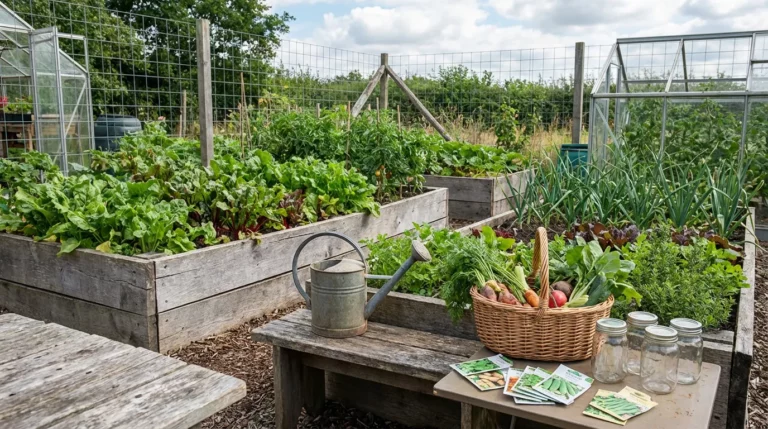
If the grocery store closed tomorrow, could your yard feed your family? For most households the honest answer is no—not even close. The gap between wanting to garden and actually producing meaningful calories is skill and planning. This guide covers both: how to build a survival garden from the ground up, what to plant for maximum food security, and how to preserve what you grow so it feeds your family through any emergency.
How Much Garden Does a Family of 4 Actually Need?
The answer depends on your goal. Full caloric self-sufficiency (feeding four people entirely from your property year-round) requires 1,000–2,000 square feet of productive garden space managed intensively. That is possible but it is a multi-year project requiring serious skill development.
A more realistic starting target: enough garden to cover 30–50% of your family’s vegetable and calorie needs. At that scale, you need 200–400 square feet of intensively managed raised beds. That is four to eight 4×8 beds—achievable in a standard suburban backyard this spring.
| Goal | Space Needed | Time to Produce | Realistic For |
|---|---|---|---|
| Fresh greens supplement | 50–100 sq ft | 4–6 weeks | Any backyard or patio |
| 30–50% vegetable supply | 200–400 sq ft | First season | Most suburban yards |
| Meaningful calorie production | 500–800 sq ft | 2–3 years of skill building | Dedicated homesteaders |
| Full family food production | 1,000–2,000+ sq ft | 3–5+ years | Experienced gardeners on larger lots |
💡 Tip: Start with 4 raised beds, not 20
The most common survival gardening failure is starting too large and abandoning it by August. Four 4×8 beds is 128 square feet—manageable for a family with no gardening experience and genuinely productive if planted with the right crops. Master those four beds this season. Expand next year from a position of competence, not ambition.
Plant Calories First, Flavor Second
A survival garden is not a culinary garden. You are not optimizing for restaurant-quality tomatoes. You are optimizing for calorie density, storage life, and yield per square foot. Most beginner gardens are planted almost entirely with salad crops: lettuce, cucumbers, peppers, herbs. These are delicious. They are not calorie crops. They will not feed your family through a two-week emergency, let alone a season-long disruption.
The crops that actually matter for food security:
| Crop | Calories/Cup | Yield per Plant | Storage Life | Notes |
|---|---|---|---|---|
| Potatoes | 116 cal | 2–3 lbs | 3–6 months (root cellar) | Highest calorie per sq ft of any vegetable |
| Sweet Potatoes | 115 cal | 5–10 tubers | 3–6 months | Heat-tolerant; stores without refrigeration |
| Dried beans | 200 cal + 15g protein | Season-long | 10+ years dried | Double duty: fresh green beans + dried storage |
| Winter squash | 50–80 cal | 5–10 lbs per vine | 3–6 months | Butternut and acorn store longest |
| Dent corn (dry) | 370 cal/cup dried | 1–2 ears per stalk | Years dried | Grinding corn; not sweet corn |
| Kale and chard | 33–35 cal | Continuous harvest | Short-term fresh | Cold-hardy to 20°F; extends season into winter |
| Tomatoes | 32 cal | 10–30 lbs | Short-term; cans well | Include for canning; high-yielding and preservable |
Rule of thumb for a family of four: dedicate at least 60% of your garden space to calorie crops (potatoes, beans, squash). Use the remaining 40% for nutrition crops (kale, chard, beets, carrots) and fresh eating crops (tomatoes, cucumbers, peppers). If space is limited, cut the fresh eating crops first.
How to Pick the Right Garden Location
Sun is non-negotiable. Vegetables need a minimum of 6 hours of direct sunlight daily; 8–10 hours is optimal. Before you break ground or build a single raised bed, spend a full day watching where the sun hits your yard and for how long. Shade from a fence or large tree that seems minor in the morning can eliminate afternoon sun entirely.
Three other location factors that matter:
- Water access: You need a hose or water source within 50 feet. Carrying water by hand to a distant garden fails by week three.
- Drainage: Standing water kills most vegetable roots within 48 hours. To test: dig a hole 12 inches deep, fill it with water, and check back in an hour. If water remains, you need raised beds or serious drainage work.
- Distance from large trees: Tree roots extend 2–3 times the width of the canopy underground. They will invade garden beds and compete aggressively for water and nutrients. Keep your garden at least 10 feet from the drip line of any large tree.
Soil Preparation: The Work That Determines Everything
More gardens fail from poor soil than from any other cause. Seeds and transplants are cheap. Time and effort invested in crops that never produce because the soil is wrong is not. Test before you plant.
The $15 Soil Test
A basic soil test kit from a garden center (~$15) tells you pH and major nutrient levels. Most vegetables need a pH between 6.0 and 7.0. Outside that range, plants cannot absorb nutrients regardless of how much fertilizer you add. If your pH is off:
- Too acidic (below 6.0): Add agricultural lime (~$8 for 40 lbs). Apply at 5 lbs per 100 sq ft and retest in 30 days.
- Too alkaline (above 7.5): Add elemental sulfur (~$10 for 5 lbs). Apply per package directions and retest.
Soil Amendment Recipes by Type
| Soil Type | Amendment Recipe (per 5 gal soil) |
|---|---|
| Sandy (drains too fast) | 5 gal sandy dirt + 5 gal compost/manure + 1 cup 10-10-10 fertilizer |
| Heavy clay (drains too slow) | 5 gal clay + 5 gal coarse sand + 10 gal compost/manure + 2 cups fertilizer |
| Dark moist loam (good base) | 5 gal coarse sand + 5 gal loam + 1 cup 10-10-10 fertilizer |
| Raised bed fill (from scratch) | 60% topsoil + 30% compost + 10% perlite or coarse sand |
For raised beds, the Mel’s Mix formula from “Square Foot Gardening” is battle-tested: 1/3 blended compost, 1/3 peat moss or coconut coir, 1/3 coarse perlite. A 4×8 bed filled 12 inches deep needs about 32 cubic feet of mix (~$80–$120 in materials).
Building Your First Raised Bed
Raised beds outperform in-ground planting in almost every way for a suburban survival garden: better drainage, warmer soil in spring, no compaction, built-in gopher protection, and less back strain for daily maintenance. The investment is modest.
✅ Action: Build one 4×8 raised bed this weekend
Materials for one 4×8×12” bed (~$75 total):
- 3 boards of 2×12 cedar or redwood, 8 ft long (~$45): cut two to 4 ft for the ends
- 4 corner posts of 4×4 cedar, 18” long (~$10)
- 1 roll of ¼” hardware cloth for gopher protection (~$12)
- Exterior-grade screws, 3” (~$5)
- 32 cubic feet of soil mix (~$80–$120): buy in bulk from a landscape supply yard
Build time: 2–3 hours with basic tools. One 4×8 bed can produce 50–100 lbs of vegetables in a single season if planted with high-yield crops and maintained consistently.
The Prepper’s Planting Calendar
Timing is the single most important factor most new gardeners get wrong. Planting warm-season crops too early (before last frost) kills them. Planting cool-season crops too late means they bolt in summer heat. Know your USDA hardiness zone and last frost date—every planting decision flows from that.
| Season | Crops to Plant | Timing |
|---|---|---|
| Early Spring | Kale, spinach, lettuce, peas, broccoli, onions, potatoes | 2–4 weeks before last frost |
| Late Spring | Tomatoes, peppers (transplants), beans, squash, cucumbers, sweet corn | After last frost date, soil 60°F+ |
| Early Summer | Sweet potatoes, second succession of beans, dent corn | When soil is consistently warm (65°F+) |
| Late Summer | Fall kale, spinach, turnips, carrots, garlic (for next year) | 8–10 weeks before first fall frost |
| Winter (mild climates) | Kale, chard, spinach (with row cover or cold frame protection) | Zones 7+ with minimal protection |
💡 Tip: Succession planting prevents feast-and-famine cycles
Plant beans every 2 weeks from last frost through mid-July instead of all at once. This spreads your harvest across 3 months instead of a 3-week glut. Same principle applies to lettuce and spinach in spring. Succession planting is the difference between a functional food garden and a compost pile full of bolted greens.
Harvesting and Preserving What You Grow
Growing food is only half the equation. A bushel of tomatoes that rots on the counter because you had no preservation plan is wasted effort. Every calorie crop in your survival garden needs a preservation strategy before you plant it.
Three Core Preservation Methods
- Canning (water bath for high-acid, pressure canner for low-acid): The Ball Complete Book of Home Preserving (~$18) is the authoritative reference. An All American pressure canner (~$250) handles beans, potatoes, and meat—the calorie crops that need pressure canning to be safe. A water bath canner (~$30) handles tomatoes, pickles, and jams.
- Dehydrating: The Nesco FD-75A food dehydrator (~$60) handles most garden produce. Dehydrated tomatoes, beans, herbs, and sliced sweet potatoes store for 1–3 years in airtight containers. Takes up 90% less space than canned.
- Root cellaring: Potatoes, sweet potatoes, winter squash, and carrots store for months without electricity in a cool (35–45°F), dark, humid environment. A corner of an unheated basement or a buried cooler can function as a root cellar.
⚠️ Warning: Never pressure-can using improvised recipes
Low-acid vegetables (beans, potatoes, corn, meat) must be pressure-canned at specific temperatures and times to prevent botulism. Water bath canning low-acid vegetables is dangerous even if the seal looks good. Use only tested recipes from the Ball Blue Book or USDA Complete Guide. The $250 pressure canner is not optional if you are preserving calorie crops.
Seed Saving: The Long Game
Open-pollinated (OP) and heirloom varieties produce seeds that grow true to the parent plant. Hybrid seeds (labeled F1) often do not. For a survival garden, plant at least 50% open-pollinated varieties so you can save seed year over year:
- Easy to save: beans, peas, tomatoes, peppers, squash
- Moderate skill required: corn (needs isolation from other varieties), kale, lettuce
- Seed storage: dried, sealed in glass jars in a cool dark location. Most seeds remain viable 3–5 years; beans and tomatoes up to 5–10 years properly stored.
Common Mistakes in Survival Gardening
1. Planting only salad crops. Lettuce and cucumbers are enjoyable. They are not survival food. A garden with no potatoes, no beans, and no storage squash will not feed your family through any meaningful disruption. Allocate at least 60% of your space to calorie crops from year one.
2. Starting too large and burning out. Four intensively managed raised beds consistently outproduce 20 neglected rows. Weeds, pests, and irregular watering compound fast on large gardens. Start with what you can maintain perfectly, not what looks impressive in April.
3. No preservation plan. A 30-lb potato harvest stored improperly will sprout and rot within 6 weeks. Learn to can, dehydrate, or root-cellar before your first major harvest. The preservation skill takes time to develop—practice in year one, rely on it in year two.
4. Skipping soil amendment. Most native soils will produce poor results without amendment. The $15 soil test and $30 worth of amendments can double your yield. There is no shortcut around soil health.
5. No water plan for emergencies. Municipal water can be disrupted precisely when a crisis garden matters most. Install a 55-gallon rain barrel under a downspout (~$80) as your minimum water backup. For a serious survival garden, consider a 275-gallon IBC tote (~$150 used).
6. All hybrids, no seed savings. If you cannot reproduce your seeds, your survival garden depends on the same supply chain you are trying to become independent of. Convert at least half your plantings to open-pollinated varieties this season.
FAQ
What is the single best crop for a first-year survival garden?
Potatoes. They produce more calories per square foot than almost any other vegetable, they grow reliably in most climates, they store for months without electricity, and they are forgiving for beginners. A 4×8 raised bed planted exclusively with potatoes will yield 50–80 lbs—meaningful food production from one bed. Plant Yukon Gold for fresh eating and Kennebec or Russet for storage.
How much garden space does a family of four need to be truly self-sufficient in food?
Realistically 1,500–2,000 square feet of intensively managed beds, plus fruit trees and perennials, plus small livestock for protein. That is a 3–5 year project requiring serious skill development. Most families are better served targeting 25–50% food production from 300–500 square feet in the first two years and scaling from there. Partial self-sufficiency achieved consistently beats ambitious goals that collapse under maintenance burden.
Can I build a survival garden in an apartment or on a balcony?
Yes, but your calorie production will be very limited. Containers can support herbs, lettuce, cherry tomatoes, and peppers well. For meaningful calorie production (beans, potatoes, squash), you need at least 10–15 gallons of soil per plant and a minimum of 6 hours of direct sun. A 30-gallon fabric grow bag of potatoes on a sunny balcony can yield 10–15 lbs. Scale what is possible, combine container gardening with a stocked pantry, and consider community garden plots for larger plantings.
What seeds should I stockpile for emergencies?
Focus on high-yield, open-pollinated calorie and nutrition crops: bush beans (Provider or Contender varieties), potatoes (store as seed potatoes or plant tubers), kale (Red Russian or Siberian), butternut squash, sweet corn (Bloody Butcher or Country Gentleman for drying), and tomatoes (San Marzano for canning). Store seeds in a sealed glass jar with a silica gel packet in a cool, dark location. Replace every 3–5 years or test germination rates annually.
How do I deal with pests without depending on chemical pesticides?
The two most important tools are crop rotation (never plant the same family in the same bed two years in a row) and row cover fabric (Agribon AG-19, ~$15 for 50 feet) which physically blocks most insect pests while allowing light and water through. Diatomaceous earth (~$12 for 4 lbs) applied at soil level controls slugs and crawling insects. For aphids and soft-bodied insects, a $0.50 solution of castile soap in water applied with a spray bottle works reliably. Chemical dependence is the opposite of a survival garden philosophy.
A survival garden is not built in a season—it is built in a decision and then a series of consistent actions that compound over years. Start with four beds, plant calories first, preserve what you harvest, and save your seeds. Each year your skills improve, your soil gets better, and your family’s food independence grows. The families who have productive food gardens when they need them are the ones who started building them when they did not.

Dan Lockland is a preparedness instructor and survival skills educator with over 15 years of hands-on experience. He shares practical, no-nonsense guidance on emergency preparedness, self-reliance, and sustainable living at PreparingWithDan.com.