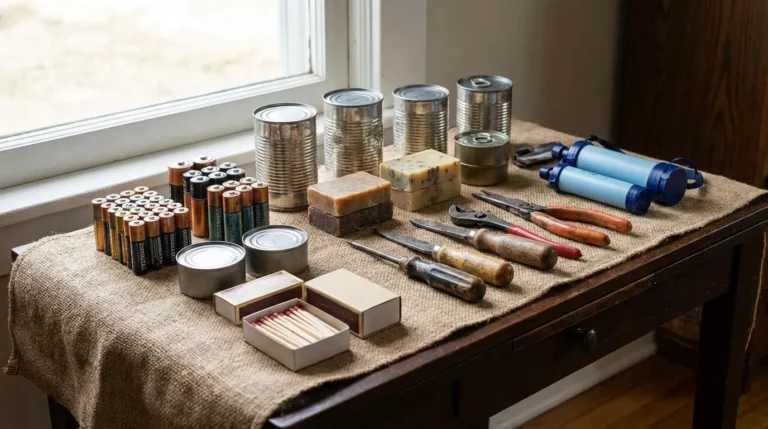
Bartering isn’t a post-apocalypse fantasy — it’s what happens in every extended emergency where normal commerce breaks down. After Hurricane Katrina, the 2011 Japan earthquake, and extended community blackouts, informal barter networks formed within 48–72 hours. People who had extra fuel, batteries, or medical supplies traded them for food, labor, and equipment. Knowing what to stock and how to negotiate safely is a legitimate preparedness skill.
Table of Contents
- How Barter Markets Form in Emergencies
- The 20 Best Items to Stockpile for Barter
- Skills Worth More Than Cash
- What’s Not Worth Bartering (Low Value, High Risk)
- Safety Rules for Bartering in a Crisis
- How to Negotiate in a Barter Situation
- Common Mistakes
- FAQ
How Barter Markets Form in Emergencies
Formal barter markets don’t appear on day 1 of an emergency — they appear around day 2–5, once people have assessed what they have and what they need. The typical progression:
- Days 1–2: People use what they have and rely on stored goods
- Days 3–5: Immediate consumables (fuel, batteries, food) start to run short; informal neighbor-to-neighbor trades begin
- Week 2+: Community barter networks form at neighborhood level; skills become as valuable as goods
The key insight: barter value in a crisis is determined by scarcity + urgent need + divisibility. Something that everyone ran out of, that creates immediate suffering when absent, and that can be split into small units commands the highest value. This is why fuel, batteries, and small-denomination medications (ibuprofen) consistently top barter lists from every major extended emergency.
The 20 Best Items to Stockpile for Barter
| Item | Barter value | Why | Cost to stock |
|---|---|---|---|
| Butane/propane lighters | Very High | Universal need, overlooked, cheap, small | $1–$2 each (stock 20+) |
| AA/AAA batteries | Very High | Powers flashlights, radios; runs out fast | ~$0.50/each in bulk |
| Over-the-counter pain relievers (ibuprofen, acetaminophen) | Very High | Immediate comfort need; small and divisible | $5–$8 per bottle (500 ct) |
| Fuel (gasoline, propane canisters) | Very High | Critical shortage in most grid-down events | Variable; store safely |
| Alcohol (mini spirits, whiskey) | High | Comfort item + antiseptic use; doesn’t expire | $1–$3/small bottle |
| Antibiotics (fish-grade amoxicillin) | High | Medical need with no pharmacy access | ~$15/bottle (consult a doctor) |
| Feminine hygiene products | High | Consistently overlooked in preps; high demand | ~$5/pack |
| Toilet paper | High | COVID demonstrated this clearly | $0.50–$1/roll in bulk |
| Salt, sugar, cooking oil | High | Cooking staples that extend food supply | $3–$6/item |
| Coffee, instant | High | Comfort item; high perceived value among addicts | $8–$12/jar |
| Cigarettes (if you don’t smoke) | High | Addiction creates consistent demand regardless of crisis | $8–$12/pack |
| N95 masks | High (situational) | High value during fire/fallout/pandemic events specifically | ~$1–$2 each in bulk |
| Water purification tablets (Aquatabs) | High | Small, cheap to stock, critical need | $8/30 tablets |
| Candles | Medium–High | Light when batteries run out; ambiance factor | $1–$3 each |
| Duct tape | Medium–High | Repair tool; almost infinite uses | $5–$8/roll |
| Rope / paracord (100 ft) | Medium | Utility item for repairs, building, securing | $8–$12/roll |
| Reading glasses (various strengths) | Medium | Many adults are dependent and forget spares | $5–$10/pair |
| Seeds (vegetable, non-hybrid) | Medium (long-term) | Value increases dramatically in multi-week events | $2–$5/packet |
| Fishing line and hooks | Medium | Food acquisition; very light to store | $5–$10 |
| Playing cards, dice (entertainment) | Low–Medium | Comfort items; higher value in extended events | $3–$5 |
Storage recommendation: Don’t stockpile items solely for barter — stockpile things your family would use anyway, in quantities that give you 30–60 days of surplus. Your surplus becomes your barter currency without any dedicated investment.
Skills Worth More Than Cash
In an extended emergency, skills are the only non-depletable resource. Five skill categories that have historically commanded the highest trade value:
- Medical / first aid — wound care, suturing, medication knowledge, diagnosis of common conditions. A neighbor who can treat an infected cut when no pharmacy is open is extraordinarily valuable. Take a Wilderness First Responder course ($700) or at minimum a quality Stop the Bleed + CPR certification ($50–$100).
- Mechanical / repair — small engine repair, generator maintenance, vehicle repair, welding. In a prolonged crisis, the person who can fix a generator or repair a vehicle gets paid in food and fuel.
- Food preservation — canning, dehydrating, smoking, fermentation. Knowing how to preserve a surplus harvest means your neighbor who grew too many tomatoes will pay you in produce to convert their excess into shelf-stable food.
- Construction / carpentry — repair of shelter, installation of security hardware, basic carpentry. Storm or unrest damage creates immediate demand for these skills.
- Water sourcing and treatment — well drilling, rain collection setup, water purification. Knowledge of safe water sources and treatment methods becomes critical within 72 hours of a supply disruption.
What’s Not Worth Bartering (Low Value, High Risk)
- Weapons or ammunition: High-risk trades. You’re either trading safety assets to someone who may become a threat, or signaling that you have valuable items worth taking. Avoid entirely.
- Prescription medications you need: Never trade away items your family depends on. Only trade true surplus.
- Gold and silver (in short-term emergencies): In a 72-hour to 2-week event, most people will trade food for food, not gold for food. Precious metals become valuable in very long-duration events — for 95% of emergency scenarios, physical goods and skills outperform PMs as barter currency.
- Electronics: Difficult to value, condition-dependent, and rarely an urgent need in a crisis. Stick to consumables.
Safety Rules for Bartering in a Crisis
Barter in a crisis introduces security risks that normal commerce doesn’t. Follow these rules:
- Never barter at your home or reveal your storage location. Meeting people at a central community location (a neighbor’s yard, a street corner) keeps them from knowing what you have stored. Once people know you have fuel or medicine, you become a target.
- Don’t advertise your surplus in advance. Word of an extensive stockpile spreads. Trade from apparent modest surplus, not from a display of abundance.
- Trade in groups, not alone. Always have another adult present during trades, especially with strangers or people you don’t know well.
- Establish value before need is urgent. A trade where one party is desperate and the other has leverage creates bad blood. In a tight community, being known as fair builds the social capital that matters more than any single trade.
- Consider the downstream effect. Trading someone a weapon, excessive alcohol, or medications that will be misused can create problems in your neighborhood. Think about the end use, not just the immediate exchange.
How to Negotiate in a Barter Situation
Barter negotiation differs from cash transactions in one key way: there’s no universal price anchor. The “price” of anything in a barter is what both parties agree to, which means your negotiating position depends entirely on perceived scarcity and need.
Practical guidelines:
- Know your floor: What’s the minimum you’d accept before the trade isn’t worth it? Know this before you sit down to negotiate.
- Start higher than your floor: Leave room to concede. The other party needs to feel they negotiated something down.
- Offer bundles: “3 lighters + a bottle of ibuprofen for your extra fuel canister” is often more attractive than a single-item trade — you’re solving multiple problems at once.
- Be willing to walk away: The best negotiating position is genuine willingness to not trade. If you need the item more than they do, don’t show it.
- Build relationships, not transactions: In a community emergency, the neighbor you treated fairly in week 2 is the one who warns you about security problems in week 4. Every trade is a relationship investment, not just a transaction.
Common Mistakes in Emergency Bartering
- Bartering away items you actually need. People trade fuel canisters and then realize their cooking stove has no fuel. Determine your 30-day household needs first. Everything beyond that quantity is potential trade surplus — not before.
- Advertising your stockpile. Telling neighbors you have 6 months of food makes you a resource target in an extended emergency. Trade from modest apparent surplus. Keep your actual storage private.
- Stockpiling purely for barter without considering your own use. Buying 100 packs of cigarettes for barter when nobody in your household smokes is fine — but if you need those storage dollars for your own food supply, prioritize your family first. Barter inventory is built from surplus, not at the expense of your core prep.
- Ignoring skill development in favor of goods. $500 invested in a first aid course or a welding certification returns more barter value than $500 of extra goods — and skills can’t be taken from you. Balance your investment between goods and capabilities.
- Trading in high-visibility locations. Conducting trades on your front porch or in your driveway tells the neighborhood what you have and who has it. Use a neighbor’s yard or a community gathering point for exchanges.
FAQ
What are the best items to stockpile for bartering?
Lighters, batteries, over-the-counter pain medication (ibuprofen, acetaminophen), and fuel rank highest — small, in universal demand, depleted quickly, and easy to store. Comfort consumables (coffee, alcohol, tobacco) come next. Stock these as part of your regular prep surplus; they serve your family first and become barter goods second.
Are skills more valuable than goods for bartering?
In events longer than 2 weeks, yes. First aid knowledge, mechanical repair, food preservation, and water treatment skills command consistent trade value throughout an extended emergency — and can’t be stolen or depleted. In short-term events (under a week), physical consumables have more immediate exchange value. The ideal prep includes both.
Is it safe to barter with strangers during an emergency?
It can be, with precautions. Never trade at your home. Always have another adult present. Trade at a community location. Start with small exchanges to establish trust before larger trades. Don’t reveal the extent of your storage. People who have traded fairly in your neighborhood build safety capital that’s worth more than any individual trade.
Should I stockpile gold or silver for bartering?
Only for very long-duration events (months+). In a standard 72-hour to 2-week emergency, most people will trade consumables for consumables — food, fuel, medication — not precious metals for goods. Physical goods with immediate utility are far more effective barter currency in the scenarios most families will actually face. If you’ve fully covered your consumable prep, adding a small precious metals position makes sense for long-term insurance.
How do I keep from being taken advantage of in barter trades?
Know your floor before negotiating. Be willing to walk away from bad trades — urgency is visible and exploitable. Trade from apparent modest surplus, not desperate need. Build relationships with neighbors before an emergency, so trades happen in a context of mutual trust rather than one-off opportunistic exchanges. And always remember: being known as fair and reliable in your community is a long-term survival asset.
Bottom Line
The most practical barter prep costs under $100 and is built from items your family uses anyway: a surplus of lighters, batteries, ibuprofen, and coffee. Add a first aid course and basic mechanical skills and you have both the goods and the skills that command consistent trade value in every extended emergency scenario. For the broader prep kit that these items fit into, see How to Build Your Emergency Kit on a Budget. For a complete family plan, see How to Build a Custom Family Emergency Plan.
Last Updated: April 2026

Dan Lockland is a preparedness instructor and survival skills educator with over 15 years of hands-on experience. He shares practical, no-nonsense guidance on emergency preparedness, self-reliance, and sustainable living at PreparingWithDan.com.