
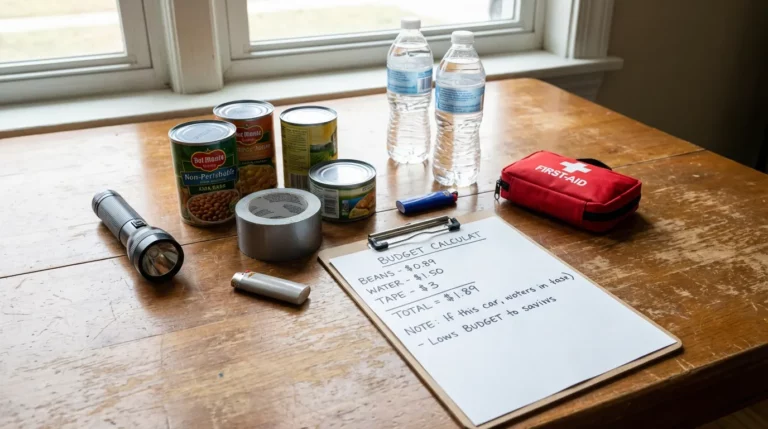
A complete 72-hour emergency kit for a family of 4 costs $150–$200 built from scratch — not $500, not $800, and definitely not the $300+ pre-assembled kits that contain a lot of things you don’t need and skip things you do. The math is simple once you know the right list. This guide gives you the exact items, the exact prices (2026), and a $5/week accumulation plan if you need to spread the cost.
Table of Contents
- What Not to Buy (The Pre-Made Kit Problem)
- The Complete Budget Kit List with Prices
- Category-by-Category Breakdown
- Where to Buy Cheap Without Sacrificing Quality
- The $5/Week Build-Up Plan (20 Weeks to Done)
- Items You Already Own or Can Get Free
- Common Mistakes
- FAQ
What Not to Buy (The Pre-Made Kit Problem)
Pre-assembled emergency kits at $200–$400 are almost always a bad deal. They’re designed for marketing, not emergencies. Common problems:
- Way too little food — many “72-hour” kits include 1,200–1,500 calories per person per day, which is starvation-level for an adult under stress
- Low-quality flashlights — cheap LEDs that fail after 30 minutes of use
- Useless extras — ponchos, emergency whistles, and mylar blankets that add cost and rarely justify it at the price premium
- Mismatched components — items that work independently but don’t integrate (e.g., a radio with no batteries included)
Exception: FEMA’s Ready.gov list is free and accurate. Use it as a checklist, not a shopping cart. Buy items individually and you’ll spend 30–50% less than a comparable pre-made kit.
The Complete Budget Kit List with Prices
Total estimated cost: $145–$200 for a family of 4 (2026 prices)
| Item | Qty | Budget price | Where to buy |
|---|---|---|---|
| Water (1 gal jugs, store-bought) | 12 | $12 ($1/gal) | Walmart, grocery store |
| Manual can opener | 2 | $8 ($4 each) | Dollar Tree, Amazon |
| Canned beans (15 oz), assorted | 12 cans | $12 | Walmart, Aldi |
| Canned tuna / sardines | 8 cans | $12 | Walmart, Costco |
| Peanut butter (40 oz) | 2 jars | $10 | Walmart |
| Crackers (Saltines or Triscuits) | 4 boxes | $8 | Grocery store |
| Oatmeal (quick-cook, 2 lb) | 2 bags | $6 | Walmart, Aldi |
| First aid kit (basic, 100-piece) | 1 | $15 | Amazon, Walmart |
| Headlamp (Energizer or Black Diamond) | 4 | $40 ($10 each) | Amazon, Walmart |
| AA batteries (24-pack) | 1 | $10 | Costco, Amazon |
| Hand crank / battery NOAA radio (RunningSnail) | 1 | $28 | Amazon |
| Power bank (10,000 mAh, Anker or Xiaomi) | 1 | $25 | Amazon |
| Emergency mylar blankets (4-pack) | 1 | $8 | Amazon |
| N95 masks (10-pack) | 1 | $12 | Amazon, Home Depot |
| Waterproof document bag | 1 | $8 | Amazon |
| Cash in small bills | $100 | $100 (from savings) | ATM before an event |
| Total (excluding cash) | ~$214 | ||
| Total (with $100 cash reserve) | ~$314 |
Note: You can build a functional kit (everything except NOAA radio, power bank, and cash) for under $100. Add those items as budget allows.
Category-by-Category Breakdown
Water: $12 for 3 days (family of 4)
1 gallon per person per day × 4 people × 3 days = 12 gallons. At $1/gallon, this is $12. Store-bought water jugs require no rotation for 1–2 years. Alternatively, fill 2-liter soda bottles or food-grade containers with tap water — free, but requires annual rotation. Either works.
Food: $48 for 3 days (family of 4)
Goal: 2,000 calories per person per day = 24,000 total calories. The budget combination of peanut butter, crackers, canned beans, canned tuna, and oatmeal delivers this at roughly $48. No cooking required for most items. No special storage needed. Shelf life: 1–5 years depending on item.
Light: $50 for 4 headlamps + batteries
One headlamp per person is the correct answer — not a single flashlight shared by 4 people. Headlamps keep hands free for tasks. Budget headlamps ($10 each) from Energizer or Cree hold up fine for emergency use. Include 24 AA batteries (most headlamps run on 3 AAs; the pack covers 2 headlamp sets plus spares for the radio).
Information and power: $53
A budget NOAA weather radio (RunningSnail MD-090P, ~$28) covers the critical information need when cell service goes down. A 10,000 mAh power bank (~$25, Anker Powercore Slim) provides 2–3 full phone charges. Both are genuinely necessary; neither needs to be premium.
Medical and documents: $23
A 100-piece first aid kit ($15) and a waterproof document bag ($8). Copies of IDs, insurance cards, prescriptions, and emergency contacts go in the bag. This step takes 30 minutes and costs nothing except the bag — but most families skip it until they’re in an evacuation and realize they have no proof of identity.
Where to Buy Cheap Without Sacrificing Quality
| Category | Best budget source | Notes |
|---|---|---|
| Food (canned, dry) | Aldi, Walmart, Costco (bulk) | Aldi consistently beats Walmart on canned goods by 10–20% |
| Water jugs | Any grocery store, Walmart | $1/gallon is the standard; don’t pay more |
| First aid kit | Amazon (search “100-piece first aid kit”) | Avoid Dollar Tree medical kits — inadequate for real first aid |
| Headlamps | Amazon, Walmart outdoor section | Energizer HDL33A ~$10; good enough for emergencies |
| Batteries | Costco, Amazon (AmazonBasics) | Buy in bulk; check price per battery, not per pack |
| NOAA radio | Amazon | RunningSnail MD-090P is the best value; avoid $15 no-name units |
| Power bank | Amazon | Anker and Xiaomi are reliable brands at budget prices |
| Mylar blankets | Amazon, Dollar Tree | Dollar Tree 4-pack is fine — these rarely fail |
| N95 masks | Amazon, Home Depot | 3M Aura or Moldex at under $2/mask in 10-packs |
The $5/Week Build-Up Plan (20 Weeks to Done)
If you can’t spend $150 at once, $5/week spread over 20 weeks builds a complete kit. Here’s the priority order — this sequence ensures you have the most critical items earliest:
| Week | Buy this | Cost | What it covers |
|---|---|---|---|
| 1 | 4 gallons water + manual can opener | $8 | Water for 4 people for 1 day; can open cans |
| 2 | Peanut butter (40 oz) + crackers (2 boxes) | $9 | Emergency food for 2 days for 4 people |
| 3 | 2 headlamps + batteries (AA 12-pack) | $25 | Light for 2 people; the most urgent missing item |
| 4 | 8 cans beans/chili + 4 cans tuna | $14 | Protein and calories for 3 days |
| 5 | 2 more headlamps (for remaining family members) | $20 | Full family light coverage |
| 6 | 4 more gallons water (up to 8 total) | $4 | 2 days water for 4 people |
| 7 | First aid kit (100-piece) | $15 | Medical basics |
| 8 | RunningSnail NOAA radio | $28 | Emergency information when cell is down |
| 9 | Anker 10,000 mAh power bank | $25 | Phone charging |
| 10 | Final 4 gallons water (12 total), oatmeal (2 bags) | $10 | Complete 3-day water supply; breakfast covered |
| 11–20 | Cash ($10/week in $5 and $20 bills) | $100 | ATM-independent cash reserve; store with kit |
By week 10, you have a fully functional 72-hour kit for under $160 — just without the cash reserve. By week 20, the kit is complete.
Items You Already Own or Can Get Free
Before buying anything, check these sources:
- Old water containers: Thoroughly cleaned 2-liter soda bottles work perfectly for water storage — free
- Blankets and warm clothes: You own these; put a set in a waterproof bag in your kit
- Medications: Ask your doctor or pharmacist for an emergency supply (7–14 days); covered by most insurance
- Documents: Scan IDs, insurance cards, and prescriptions to a USB drive — takes 20 minutes, costs nothing
- Plastic bags (for waterproofing): Ziploc bags you already have
- Multi-tool: If you own one, add it to the kit — don’t buy a duplicate
- Canned goods already in your pantry: Add a rotating stock of canned beans and tuna to your existing pantry rather than buying a separate “emergency” supply
Common Mistakes When Building a Budget Emergency Kit
- Buying a pre-made kit because it seems convenient. A $200 pre-made “72-hour family kit” typically contains $60–$80 worth of goods at retail prices. You’re paying $120–$140 for packaging and assembly. Spend 45 minutes and build your own — you’ll get a better kit for half the price.
- Starting with the wrong items. Many budget preppers buy a tactical backpack, a multi-tool, and mylar blankets first — then run out of money before buying water and food. Start with water, food, and light. Everything else is nice-to-have.
- Not owning a manual can opener. You now own 12 cans of food and no way to open them. This is the most common and most avoidable prep failure. Manual can openers cost $4 at Dollar Tree. Buy two.
- Buying the cheapest possible radio. A $12 no-name hand crank radio from Amazon will often fail within the first year. The $28 RunningSnail or $35 Midland entry-level models are the budget floor for a reliable NOAA radio — don’t go below that threshold.
- No cash in the kit. ATMs, card readers, and mobile payment systems all go down in major emergencies. A $100 reserve in $5 and $20 bills costs nothing to maintain and has solved more practical emergency problems (gas, food, motel rooms during evacuation) than almost any piece of gear in the kit.
FAQ
How much does a 72-hour emergency kit cost for a family of 4?
Built from scratch, $145–$200 for the full kit (excluding cash reserve). The core functional kit — water, food, light, first aid, and a NOAA radio — costs about $115–$140. A pre-made equivalent kit typically costs $200–$300 for the same coverage. Building your own takes an hour and saves $75–$150.
What’s the most important item to buy first?
Water, then light. A gallon of water costs $1. A headlamp costs $10. These two categories cover the most critical survival needs at the lowest possible price point. A manual can opener ($4) is the third priority — it unlocks your entire canned food supply. Get these three before anything else.
Can I build an emergency kit for under $50?
Yes, for a single person’s 72-hour basics: 3 gallons of water ($3), canned goods for 3 days ($15), peanut butter and crackers ($10), a headlamp and batteries ($12), and a manual can opener ($4) = $44. This doesn’t include a NOAA radio or first aid kit — add those as soon as budget allows. For a family of 4, multiply food and water by 4 and add 3 more headlamps.
Should I buy freeze-dried emergency food to save space?
Not for a budget kit — freeze-dried meals cost $8–$12 per serving vs. $0.50–$1.00 per serving for canned goods and dry staples. For a 72-hour kit, stick with peanut butter, crackers, canned beans, and tuna. Freeze-dried meals become worthwhile for long-term storage (25-year shelf life) once the basics are covered.
Is it cheaper to build the kit over time or all at once?
All at once is cheaper — you can buy in bulk, use sales, and avoid the risk of buying partially and never finishing. If you can do it, spend the $150–$200 in one shopping session. If you genuinely can’t, the $5/week plan above works — but commit to the full 20 weeks or you’ll end up with an incomplete kit that’s less useful than nothing when you need it.
Bottom Line
A complete 72-hour emergency kit for a family of 4 costs under $200 built from scratch. The priority order is water, food, light, first aid, and a NOAA radio. Skip the pre-made kits, start with a manual can opener and 12 gallons of water, and build from there. For a more detailed kit list calibrated to your family’s specific needs, see How to Build a Custom Family Emergency Plan. For blackout cooking on a budget, see Cooking in a Blackout.
Last Updated: April 2026

Dan Lockland is a preparedness instructor and survival skills educator with over 15 years of hands-on experience. He shares practical, no-nonsense guidance on emergency preparedness, self-reliance, and sustainable living at PreparingWithDan.com.