
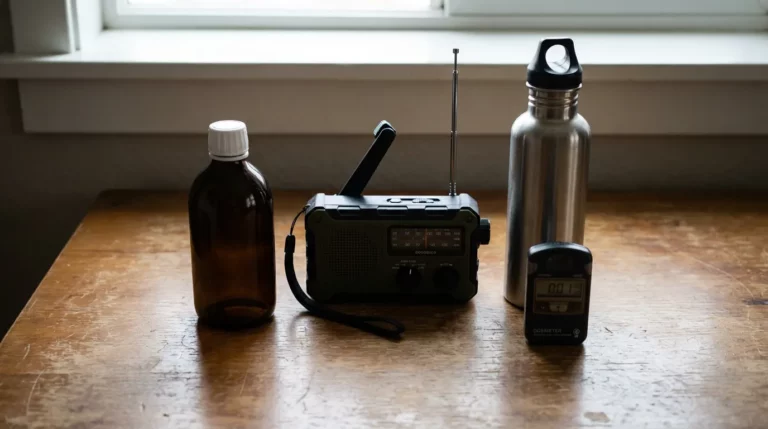
Potassium iodide is one of the most misunderstood items in a prepper’s kit. Most people know they should have it. Far fewer understand what it actually does, what it does not do, and exactly when to take it. Get this wrong and you either miss the protection window entirely, or take it when it will not help and expose yourself to unnecessary side effects. Get it right and you dramatically reduce your family’s risk of thyroid cancer following a nuclear event involving radioactive iodine release.
This guide covers everything a family of four needs to know: how KI works, the exact doses by age, the critical timing window, where to buy it, how to store it, and what it will not protect you against.
What KI Does (and Does Not) Do
Potassium iodide (KI) does one thing: it saturates your thyroid gland with stable iodine so it cannot absorb radioactive iodine-131 released during a nuclear event. The thyroid actively concentrates iodine from your bloodstream because it needs iodine to produce thyroid hormones. When iodine-131 is in your environment (from nuclear plant accidents or certain weapons), your thyroid will absorb it just like regular iodine — and the resulting radiation inside your gland causes thyroid cancer, sometimes years or decades later.
KI floods the thyroid with safe iodine first, filling the available uptake capacity so there is no room for the radioactive version. Think of it as occupying a parking lot so the bad cars cannot get in.
KI protects only the thyroid, and only from radioactive iodine. It does nothing against other types of radiation exposure (gamma rays, cesium-137, strontium-90), other radioactive particles, or whole-body radiation effects. Shelter-in-place and decontamination are your primary defenses. KI is one specific tool for one specific threat.
When KI Is Needed — and When It Is Not
Iodine-131 is most significant in these scenarios:
- Nuclear power plant accident (like Chernobyl or Fukushima): Reactor fuel contains large amounts of iodine-131. A major accident releases it into the air. Downwind populations face meaningful exposure risk.
- Nuclear weapon detonation: Fission weapons produce iodine-131 as part of their fallout. A surface burst or near-surface burst will release significant iodine-131 into local fallout.
- Dirty bomb with radioactive iodine: Less likely but possible. Emergency authorities would confirm if iodine-131 is involved.
KI is less critical or unnecessary in scenarios that do not involve iodine-131, such as:
- Radiation from a neutron bomb (produces different isotopes)
- Contamination from industrial radioactive materials (cesium, cobalt, etc.)
- Radiation exposure from X-rays or medical procedures
The practical takeaway: wait for official guidance from emergency management authorities. They will tell you whether radioactive iodine is present and whether KI is recommended for your location. Do not take KI without guidance unless you know you have been directly exposed to fallout from a nuclear detonation or plant accident.
The Timing Window: This Is Critical
Timing your KI dose is as important as taking it at all. The protection window is narrow:
| When Taken | Protection Level | Notes |
|---|---|---|
| 1–24 hours BEFORE exposure | ~100% | Ideal timing |
| At time of exposure | ~100% | Still highly effective |
| 1–4 hours AFTER exposure | ~85% | Still strongly recommended |
| 4–8 hours after exposure | ~40% | Still worth taking |
| 8–24 hours after exposure | Minimal | Little benefit |
| More than 24 hours after | None | Exposure already absorbed |
One dose of KI protects for approximately 24 hours. If iodine-131 exposure continues (as in a prolonged nuclear plant accident), health authorities may recommend additional daily doses. Do not take repeat doses on your own without official guidance — repeated doses carry more side effect risk, especially for older adults and people with thyroid conditions.
After the 1986 Chernobyl accident, Poland distributed KI to its population quickly. Thyroid cancer rates in Poland were dramatically lower than in surrounding countries that did not distribute KI. In the affected regions of Ukraine and Belarus where distribution was delayed or absent, thyroid cancer cases — especially in children — increased significantly in subsequent years. Timing the dose correctly is what made the difference.
FDA-Approved Dosing by Age
This is the FDA-approved dosing table for potassium iodide. These are the numbers to write on a laminated card and put with your KI supply:
| Age Group | Dose | Tablet Form (130mg) | Notes |
|---|---|---|---|
| Adults 18–40 years | 130 mg | 1 tablet (130mg) or 2 tablets (65mg) | Standard adult dose |
| Adults 40+ years | 130 mg | 1 tablet (130mg) | Only if exposure is significant — consult guidance |
| Pregnant or breastfeeding women | 130 mg | 1 tablet (130mg) | Protects mother and fetal thyroid |
| Adolescents 12–18 years (>150 lbs) | 130 mg | 1 tablet (130mg) | |
| Adolescents 12–18 years (<150 lbs) | 65 mg | 1 tablet (65mg) or half of 130mg | |
| Children 3–12 years | 65 mg | 1 tablet (65mg) or half of 130mg | Can crush and mix with liquid |
| Children 1 month–3 years | 32 mg | Quarter of a 130mg tablet | Mix crushed tablet with small amount of food/liquid |
| Infants birth–1 month | 16 mg | Eighth of a 130mg tablet | Use ThyroShield liquid if possible; monitor closely |
For a family of four with two adults (both under 40) and two school-age children, you need 130mg for each adult and 65mg per child per day of potential ongoing exposure. A single box of IOSAT (14 tablets of 130mg) covers two adults for 7 days. Buy at least two boxes for your family and restock before expiration.
What to Buy and Where
Only FDA-approved potassium iodide products should be used for radiation protection. The two most commonly available brands:
IOSAT Tablets (130mg, $14 for 14-tablet pack): The most widely available option. Available on Amazon, at many pharmacies, and survival supply stores. Each tablet is scored for easy splitting. This is what I keep in our supply.
ThyroSafe Tablets (65mg, $12 for 20-tablet pack): The 65mg dose is convenient for children and lighter adolescents without needing to split tablets. Good option to keep alongside IOSAT for families with kids.
ThyroShield Oral Solution (65mg/mL, $25): Liquid form ideal for infants and toddlers who cannot swallow or safely receive crushed tablets. If you have children under 3, this is worth keeping on hand.
For a family with two adults and two school-age children: 2 boxes of IOSAT 130mg (covers adults for up to 7 days) + 1 box of ThyroSafe 65mg (covers kids for up to 10 days). Total cost: about $40. Store with your go-bag documentation and laminated dosing card. Check expiration every year when you rotate your supplies.
Storage and Shelf Life
KI tablets are stable for years if stored properly. FDA-approved tablets typically have a 5–7 year shelf life from manufacture. Key storage rules:
- Store at room temperature in a cool, dry place (not in a hot garage or damp basement)
- Keep in original packaging until use — the foil blister packaging protects against moisture
- Write the purchase date on the box
- Check expiration annually when you rotate your food and supply stores
- Expired tablets do not become harmful — they lose potency. Some emergency management guidance says properly stored tablets may remain effective somewhat beyond their labeled expiration, but replace them when you can
How to Take KI (Practical Tips)
- Take with food or milk. KI on an empty stomach causes nausea and GI upset in many people. Take it with a meal or at least a glass of milk or juice to buffer the GI effects.
- Crushing tablets for children. Crush the appropriate portion with the back of a spoon, dissolve in a small amount of water, juice, or milk. The solution keeps for up to 7 days in the refrigerator.
- Swallow tablets whole if possible. KI has a metallic, slightly bitter taste that many adults find unpleasant. Swallowing whole with liquid avoids the taste.
- Continue shelter-in-place. KI does not replace shelter-in-place. Both are necessary. Sheltering reduces your overall radiation exposure from all sources; KI specifically addresses iodine-131 thyroid uptake.
Side Effects and Who Should Be Cautious
KI side effects are uncommon when taken at the correct dose for a short period, but be aware of them:
- Gastrointestinal symptoms (nausea, stomach pain): Most common side effect. Prevented by taking with food or milk.
- Metallic taste in the mouth: Harmless but unpleasant. Normal.
- Salivary gland swelling or tenderness: Rare, usually temporary.
- Iodine sensitivity reactions: Rash, hives, or more severe allergic symptoms. Rare but possible if you have iodine sensitivity.
People who should consult a physician before taking KI if time permits:
- Anyone with a known thyroid condition (hypothyroidism, hyperthyroidism, thyroid nodules)
- Anyone with a known iodine allergy
- Adults over 40 (lower thyroid cancer risk but higher sensitivity to iodine effects)
- Anyone on medications for thyroid disease, lithium, or certain diuretics
In an actual emergency, if you cannot reach a physician and official guidance recommends KI, the benefit of thyroid protection generally outweighs the risk of side effects for most people. People with thyroid conditions should discuss this in advance with their doctor and keep guidance on file with their supplies.
The Myth About Iodized Salt and Seaweed
This cannot be stated clearly enough: iodized table salt and seaweed are not substitutes for potassium iodide. The amount of iodine in iodized salt is about 77 micrograms per gram. An adult KI dose is 130 milligrams — roughly 1,700 times more iodine. To get a protective dose from table salt, you would need to consume approximately 250 grams of salt at once, which would be lethally toxic.
Seaweed contains variable iodine content and has the same problem — you would need dangerous quantities to approach a protective dose. Do not attempt this under any circumstances. Buy actual FDA-approved KI tablets.
Common Mistakes with Potassium Iodide
- Waiting for the emergency to buy KI. During an actual nuclear emergency, KI sells out within hours. Buy it before you need it and store it with your supplies.
- Taking KI too late. After 8–24 hours post-exposure, KI has little to no benefit. The protection window passes quickly. If you have it and official guidance says to take it, take it immediately.
- Taking KI without guidance or for the wrong reason. KI is specifically for radioactive iodine scenarios. Taking it as a general radiation measure does not help and adds unnecessary iodine load on your system.
- Wrong doses for children. Children need smaller doses. Using an adult dose for a young child significantly increases side effect risk. Know your child’s dose before the emergency.
- Stopping shelter-in-place after taking KI. KI protects the thyroid from one specific hazard. Your other organs, your skin, and your overall radiation exposure are still protected only by shelter. KI is not a pass to go outside during fallout.
- Not having a laminated dosing card with your KI supply. Under stress, people forget dosing instructions. A simple laminated card with the table above — tailored to your family members’ weights and ages — removes the cognitive load at the worst possible time.
Frequently Asked Questions
Does KI protect me from all the radiation in a nuclear event?
No. KI protects only the thyroid gland, and only from radioactive iodine-131. It does not protect any other organ and provides no protection against gamma radiation, neutron radiation, or other radioactive isotopes. Shelter-in-place is your primary defense against whole-body radiation exposure.
Should adults over 40 take KI?
Adults over 40 are at lower risk of radiation-induced thyroid cancer than younger people (whose thyroids are more active and absorb iodine more rapidly). However, they are also more susceptible to KI side effects. Official FDA guidance is that adults over 40 should take KI only if predicted thyroid exposure is very high. Follow official guidance from authorities in your area.
Is KI safe during pregnancy?
Yes, and it is particularly important. Radioactive iodine crosses the placenta and can damage the fetal thyroid. Pregnant women should take the standard adult dose (130mg) if exposed. The risk of fetal thyroid damage from radioactive iodine is significantly higher than the risk from the KI dose itself.
How long does one dose protect you?
Approximately 24 hours. If you are in an area with ongoing radioactive iodine release (as in a prolonged nuclear plant accident), authorities may advise daily doses. Do not self-administer repeat doses without official guidance due to cumulative iodine load concerns.
My kids are at school during an event. Will the school have KI?
Schools within 10 miles of nuclear power plants typically receive KI from state emergency management programs. Schools further away may or may not have it depending on your state. Check with your school district’s emergency management coordinator. As a backup, you can provide a sealed, labeled supply to the school nurse with written dosing instructions for your child.
The Bottom Line
Potassium iodide is a highly specific, highly effective tool for one specific nuclear threat — radioactive iodine exposure to the thyroid. For a family of four, $40 worth of FDA-approved KI, stored with a laminated dosing card, is one of the highest-value additions you can make to your nuclear preparedness kit.
The critical steps: buy it now, know the doses for every family member, understand the timing window, and take it only when official guidance says to. Combined with shelter-in-place and decontamination protocols, KI is the third leg of your nuclear protection strategy.
The thyroid cancer cases from Chernobyl that were preventable were preventable specifically because of what KI does and the window that was missed. Your family does not have to be in that window.

Dan Lockland is a preparedness instructor and survival skills educator with over 15 years of hands-on experience. He shares practical, no-nonsense guidance on emergency preparedness, self-reliance, and sustainable living at PreparingWithDan.com.