
The CDC judges a water filter by one number and it is not the number on the box. A filter with an absolute pore size of 1 micron or smaller (or NSF 53/58 cyst certification) removes parasites; 0.3 micron or smaller removes bacteria and parasites; no portable filter removes viruses. An eight-stage carbon system certified to NSF/ANSI 42 is certified for chlorine taste and odour, which is a different standard for a different job. Below, six gravity filters sorted by what the listing says they actually stop, and the CDC step most kits skip: disinfect after filtering.
Gravity filters are the household option because they need no pump, no power and no strength: fill the top, wait. Six below — two bag-style for evacuation, four countertop for the kitchen — compared on the listing’s stated pore size or element type, capacity and flow, with the catch for each. No scores, no prices. For the water to store in the first place, a gallon per person per day, use the supply calculator; for tablets to pair with any of these, our purification tablet review.
The CDC ladder, and where a gravity filter sits
- Boil for one minute (three above 6,500 ft): kills everything. The best option whenever there is fuel.
- Filter, then disinfect. The CDC’s second choice. The filter removes parasites (and bacteria if rated 0.3 micron); a chlorine, iodine or chlorine dioxide dose then kills the viruses the filter cannot. A gravity filter alone is half of this step.
- Nothing works on chemicals. Fuel, pesticides or radioactive material cannot be boiled or filtered out of water at home; use bottled or another source.
How to read a listing: ultrafiltration 0.01 micron or hollow-fibre membrane is a bacteria-and-parasite filter; ceramic element generally is too, at the pore size stated; activated carbon and NSF/ANSI 42 are taste, odour and chlorine; NSF 53 covers named health contaminants including cysts. “Removes 99.99% of bacteria” on a listing is a manufacturer claim; the pore size is the checkable fact.
At a glance
| Product | Best for | Element / capacity (listing) |
|---|---|---|
| Waterdrop gravity filter straw system | One person or a couple on the move | Hollow fibre UF / 1.5 gal |
| Practical Survival 6-gallon gravity bag system | A family camp or a shelter tap | Hollow fibre / 6 gal |
| Purewell 1.5-gallon ultrafiltration system | An apartment kitchen: small footprint, real pore size | UF 0.01 µm / 1.5 gal |
| Travel Berkey, 1.5 gallons | The established name in a compact size | Black Berkey elements / 1.5 gal |
| Survivor Filter Ultra gravity system, 2.25 gallons | A family kitchen, ceramic elements | Ceramic / 2.25 gal |
| IceJoy 8-stage countertop filter, 3 gallons | Tap-water taste in a large household — not an emergency purifier | Carbon, NSF 42 / 3 gal |
Bag-style gravity filters: for the go-bag and the car
Collapsible, light, and fast; hang from a door handle or a branch.
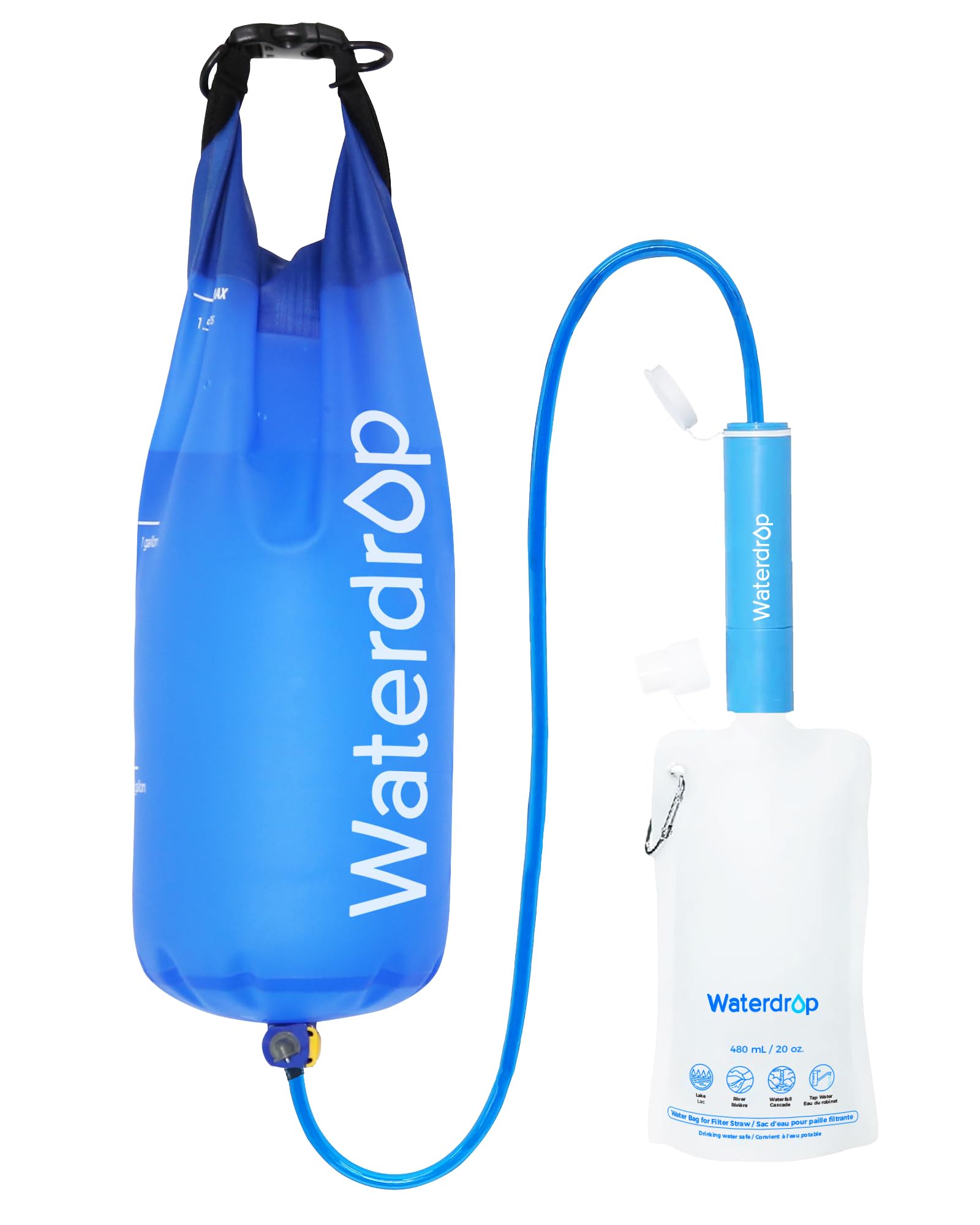
Waterdrop gravity filter straw system
For: One person or a couple on the move
What the listing says: 1.5-gallon gravity bag feeding a hollow-fibre ultrafiltration membrane, about 700 mL per minute.
Before you buy: Hollow-fibre membranes are bacteria-and-parasite filters, not virus filters: add a tablet to the output when the source is surface water. Do not let it freeze after first use; ice splits the fibres invisibly.

Practical Survival 6-gallon gravity bag system
For: A family camp or a shelter tap
What the listing says: 6-gallon gravity bag with hollow-fibre membrane, about 0.6 gallons per minute.
Before you buy: Six gallons of water weighs 50 lb: you need somewhere to hang it and a full bag to get the flow rate. Same membrane rule as above — disinfect after filtering when the source is untreated.
Countertop gravity filters: for the kitchen
Stainless steel, two elements, a spigot; the daily-use unit that is also the outage unit.

Purewell 1.5-gallon ultrafiltration system
For: An apartment kitchen: small footprint, real pore size
What the listing says: 1.5-gallon stainless steel countertop unit, two elements with 0.01 micron hollow-fibre ultrafiltration plus carbon and silver ion, stand included.
Before you buy: The 0.01 micron figure is the reason to choose this over a carbon-only unit. Replacement elements are the running cost; note the rated litres per element and keep a spare pair in the box.
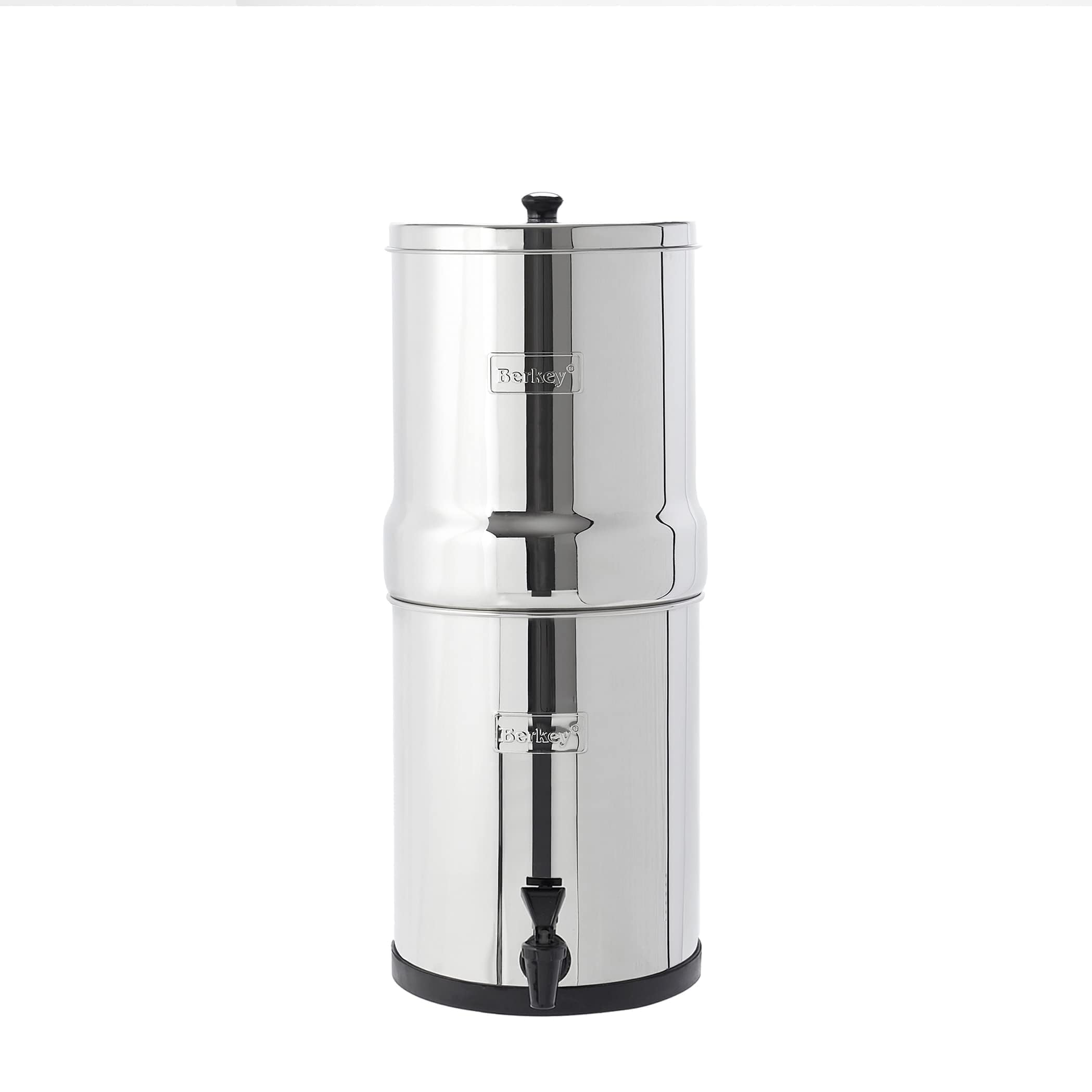
Travel Berkey, 1.5 gallons
For: The established name in a compact size
What the listing says: 1.5-gallon stainless steel unit with two Black Berkey elements, countertop footprint.
Before you buy: The listing describes the elements by name rather than by pore size; check the manufacturer’s current test data for the claim you care about. Availability and regulatory status of Berkey products in the US has changed over the years — check the listing is current before ordering elements.

Survivor Filter Ultra gravity system, 2.25 gallons
For: A family kitchen, ceramic elements
What the listing says: 2.25-gallon stainless steel unit with ceramic elements and stand, marketed for bacteria, virus and parasite removal.
Before you buy: A ceramic element removes parasites and, at a fine enough pore, bacteria; the virus claim depends on an additional stage and is the one to verify on the manufacturer’s test sheet. Ceramic cracks if dropped or frozen; inspect elements after any knock.

IceJoy 8-stage countertop filter, 3 gallons
For: Tap-water taste in a large household — not an emergency purifier
What the listing says: 3-gallon 304 stainless steel unit with an 8-stage activated-carbon system, NSF/ANSI 42 certification, stand included.
Before you buy: NSF/ANSI 42 is the aesthetic standard: chlorine, taste, odour. Eight carbon stages do not make it a microbial filter, and the listing states no pore size. Buy it for daily tap water; for an outage, pair it with boiling or tablets rather than trusting it alone.
Using one in an outage
- Pre-filter cloudy water through a cloth or coffee filter; sediment clogs elements fast and the CDC says disinfection works less well in cloudy water.
- Filter, then treat. For surface or flood water, the filtered output gets a chlorine dioxide tablet or 8 drops of unscented bleach per gallon, 30 minutes. Stored tap water that was clean going in needs the filter only for taste.
- Keep the two halves apart. Untreated water touches only the top chamber; the spigot and lower chamber stay clean. Wash hands before handling elements.
- Know the element’s life in gallons and write the install date on the base. A saturated element flows slowly and protects less.
- Never let an element freeze once wet. In a cold outage the filter comes into the warm room with you.
Our portable filter comparison covers the straws and squeeze filters for the bag; the water purification guide covers the whole ladder from boiling down.
FAQ
Does a gravity filter remove viruses?
Per the CDC, portable filters do not, whatever the stage count; the exception is reverse osmosis, which is not a gravity unit. Add a chemical disinfectant to the filtered water when the source is untreated.
What pore size do I need?
1 micron absolute or smaller for parasites such as Giardia and Cryptosporidium; 0.3 micron or smaller to also remove bacteria. Ultrafiltration membranes at 0.01-0.1 micron cover both.
Is a carbon filter useless in an emergency?
Not useless: it improves taste and removes chlorine, which makes stored or bleach-treated water drinkable. It just is not the microbial barrier, and it should not be the only step for untreated water.
Preparing with Dan is reader-supported: as an Amazon Associate we earn from qualifying purchases. Product details are as stated on the retailer listings at the time of writing; check the listing before you buy.
Official sources & further reading
The guidance in this article comes from official sources. Consult them directly for the authoritative version:

Dan Lockland is a preparedness instructor and survival skills educator with over 15 years of hands-on experience. He shares practical, no-nonsense guidance on emergency preparedness, self-reliance, and sustainable living at PreparingWithDan.com.