
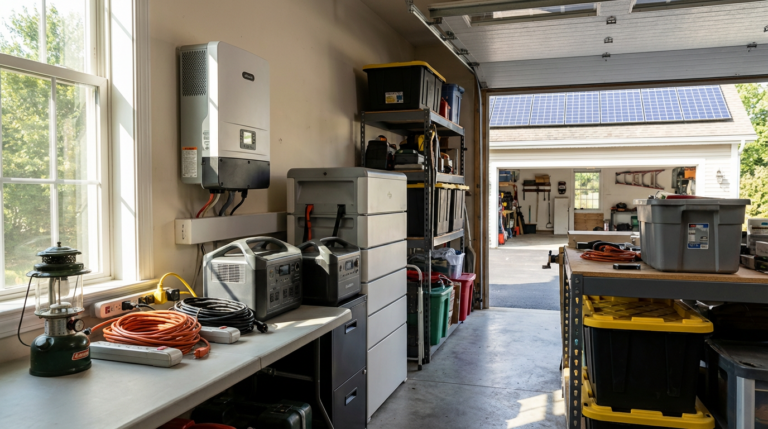
The grid fails in emergencies. That’s not a controversial statement — it’s the documented pattern in every major natural disaster of the past 30 years. After Hurricane Maria, parts of Puerto Rico were without grid power for nearly a year. After major ice storms in Texas, millions were without power for weeks. When the grid goes down, whoever has an independent power source is in a fundamentally different situation than everyone else.
Renewable energy — primarily solar — has gotten cheap enough that a functional emergency power system is now accessible to most prepper families. This article covers the practical options: what works, what it costs, and how to build a layered system that keeps critical loads running when the grid is down.
What You Actually Need to Power in an Emergency
Before buying any equipment, define the load. Most families don’t need to run their whole house — they need to run specific critical loads:
| Load | Wattage (typical) | Priority |
|---|---|---|
| Phone/device charging | 10–30W | Critical |
| LED lighting (4 bulbs) | 20–40W | Critical |
| NOAA weather radio | 5–10W | Critical |
| Refrigerator (modern, efficient) | 100–150W cycling | High |
| Chest freezer (small) | 30–60W cycling | High |
| CPAP (without heat/humidity) | 30–60W | High (medical) |
| Sump pump | 300–800W when running | Situational |
| Central air / heat | 1,000–5,000W | Low (too large for most battery systems) |
A realistic emergency power system for a family of 4 should target the first five rows. Central HVAC is impractical to run on battery storage — dress in layers or use a propane heater instead.
Tier 1: Portable Power Stations (The Starting Point)
For most prepper families, the first renewable energy purchase should be a portable power station paired with a solar panel. These are all-in-one battery + inverter units that charge via solar, wall outlet, or car. They require no installation and are ready immediately.
- Jackery Explorer 1000 Plus (~$800): 1,264Wh capacity, 2,000W AC output, expandable to 5kWh with add-on batteries. Powers a refrigerator for 12–20+ hours, charges phones for weeks, runs lighting indefinitely with solar input. The most popular mid-range unit and a solid choice for most families.
- Goal Zero Yeti 1500X (~$2,000): 1,516Wh, 2,000W AC, wi-fi monitoring, expandable battery capacity. More expensive but excellent build quality and ecosystem compatibility. Yeti 1000X (~$1,400) is the smaller sibling if budget is tighter.
- EcoFlow Delta Pro (~$1,800): 3,600Wh capacity, 3,600W AC output, fastest charge times in its class (0–80% in 65 minutes via AC), expandable to 25kWh with add-on batteries. The best choice if you need to run higher-draw appliances or want a home backup system long-term.
Tier 1: Solar Panels for Charging
Every portable power station needs a solar input strategy. Panels to pair with the units above:
- Jackery SolarSaga 200W (~$280/panel): Foldable, portable, handles partial shade reasonably well. Two panels (~$560) give you 400W input — enough to maintain a 1,000Wh battery under typical conditions during the day.
- Goal Zero Boulder 200 Briefcase (~$500): Rigid panel, more durable for fixed or semi-permanent outdoor placement. Better long-term durability than folding panels.
- Renogy 200W Monocrystalline Panel (~$150): Cheaper rigid panel if you want to mount it semi-permanently. Requires a compatible charge controller (usually included or low-cost). Best value per watt for a fixed installation.
Sizing rule of thumb: In a typical location, a solar panel produces roughly 4–5 peak sun hours per day of its rated wattage. A 200W panel produces approximately 800–1,000Wh per day. Match your panel wattage to your daily consumption to maintain battery level without grid input.
Tier 2: Whole-Home Backup with Solar + Battery Storage
For families who want to power more of their home during extended outages, a dedicated solar installation with battery backup is the next level. This requires professional installation and permits, but costs have dropped dramatically.
Battery Storage Systems
- Tesla Powerwall 3 (~$11,500 installed): 13.5kWh usable storage, 11.5kW peak output. Can power most of a home’s critical loads for 1–2 days without solar input, indefinitely with adequate solar. The most common residential battery system in the US.
- Enphase IQ Battery 10T (~$8,000–10,000 installed): 10.08kWh capacity, modular design. Alternative to Powerwall for homes with Enphase microinverter systems.
- Franklin WH10 (~$9,000–11,000 installed): 10kWh, compatible with multiple inverter brands. Competitive option worth quoting alongside Powerwall.
Solar Panel Arrays
A 6–10kW solar array (typically 15–25 standard 400W panels) costs $15,000–25,000 before the 30% federal Investment Tax Credit. After the ITC (available through at least 2032), that’s $10,500–17,500 net. Combined with a battery like the Powerwall, a whole-home system comes in at $20,000–30,000 installed, or $14,000–21,000 after tax credit.
Wind Energy: Limited Residential Applicability
Small residential wind turbines exist but have significant limitations that make them impractical for most prepper families:
- Require consistent wind averaging 10+ mph — most suburban/urban locations don’t qualify
- Zoning restrictions in most municipalities prohibit or limit tower height
- Noise and maintenance requirements
- Cost per kWh of generation is significantly higher than solar at residential scale
Wind makes sense in rural properties with consistent wind resources and no zoning restrictions. For most suburban preppers, solar is more cost-effective, more reliable, and legally simpler. A hybrid solar+wind setup on a rural property can provide better year-round generation than solar alone — wind picks up where solar drops off (cloudy days, winter).
If wind is appropriate for your situation: Windmax HY-400 400W Wind Turbine (~$350) is a starting point for a small off-grid system. For a serious rural setup, consult a local installer and assess your average wind speed data from NREL’s Wind Prospector tool before buying anything.
Microgrids: Community-Scale Resilience
A microgrid is an independent power grid that can operate disconnected from the main utility grid. At the individual property scale, a solar + battery system functions as a personal microgrid. At the community scale, multiple properties or a shared installation can form a neighborhood microgrid that provides resilience for a whole block or district.
Community microgrid projects have been funded through FEMA’s Hazard Mitigation Grant Program (HMGP) and the DOE’s Grid Resilience Innovation Partnerships (GRIP) program. If your community is in an area with frequent power outages, these funding mechanisms are worth researching through your county emergency management office.
Backup Generator: The Bridge Option
For families not yet ready for solar investment, a portable generator covers the immediate need:
- Honda EU2200i (~$1,100): 2,200W inverter generator, extremely quiet (48–57 dB), fuel-efficient, reliable. The gold standard for portable backup power. Runs a refrigerator, lighting, and device charging comfortably.
- Champion 3500W Dual Fuel (~$450): Runs on gasoline or propane. Lower cost, louder, more fuel consumption. Propane option is advantageous for long-term storage (gasoline degrades; propane doesn’t).
Generator limitations: requires fuel storage and rotation, produces carbon monoxide (never run indoors), creates noise, and requires ongoing maintenance. Solar is a better long-term solution — but a generator gets you through near-term outages while you build toward it.
Common Mistakes
- No idea what loads need to run. Buying a 1,000Wh battery without calculating what you need to run leads to either overpaying or discovering the battery isn’t adequate mid-emergency. List your critical loads and their wattages before purchasing.
- Grid-tied solar with no battery. A solar system without battery backup goes offline when the grid fails. The only exception is a system with an automatic transfer switch and battery storage. Confirm your installation includes backup capability before assuming it does.
- No fuel rotation for generators. Gasoline degrades within 3–12 months without stabilizer. Old fuel is the most common reason a generator fails on first use after sitting in storage. Store 5–10 gallons maximum, rotate every 3 months, and add STA-BIL stabilizer to extended storage.
- Undersized solar input. A 1,000Wh battery with a single 100W panel in winter may not keep up with a refrigerator load. Size your solar input to at least match your daily consumption — 200–400W for a typical critical-loads system.
- No transfer switch for whole-home generator. Plugging a generator directly into outlets is unsafe and ineffective. A proper whole-home generator connection requires a transfer switch (manual or automatic) installed by a licensed electrician. This is a code requirement, not optional.
FAQ
How much solar do I need to run a refrigerator indefinitely during an outage?
A modern Energy Star refrigerator typically uses 400–600kWh per year, or roughly 1.1–1.6kWh per day. In a location with 4 peak sun hours per day, a 300–400W solar panel array can cover that consumption. Pair it with a 1,000–1,500Wh battery to bridge overnight and cloudy periods. A 200W panel + 1,000Wh Jackery is marginal — add a second panel if the refrigerator is your primary concern.
Can I use solar panels during a hurricane or major storm?
Panels produce significantly reduced output in heavy overcast — typically 10–25% of rated output. In severe weather where panels could be physically damaged, the equipment should be secured or removed. The battery storage is what matters during a multi-day storm: charge the battery to full before storm arrival, then run off storage. Recharge from solar once conditions permit.
What’s the 30% federal tax credit and how do I claim it?
The Residential Clean Energy Credit (IRA) provides a 30% federal income tax credit for solar panels and battery storage installed at your home through at least 2032. It’s claimed on IRS Form 5695 when you file taxes. If your credit exceeds your tax liability in the installation year, the excess carries forward to future years. It applies to both the panels and the battery if both are installed. Consult a tax professional for your specific situation.
How long will a Jackery 1000 run my house?
It won’t run your house — that’s not what it’s designed for. It will run specific critical loads: a modern refrigerator for 8–12 hours, LED lighting indefinitely (with solar input), phone and device charging for weeks, and a CPAP for 1–2 nights. Think of it as a targeted critical-loads solution, not a whole-home backup. For whole-home backup, you need a 10–13kWh system like the Tesla Powerwall paired with adequate solar.
Is propane or gasoline better for a backup generator?
Propane for long-term storage; gasoline for short-term convenience. Propane has an indefinite shelf life, produces cleaner combustion, and doesn’t require stabilizer or rotation. Gasoline is more widely available in an emergency and most generators have lower upfront cost. A dual-fuel generator (like the Champion 3500) covers both scenarios: use propane from stored tanks for planned outages, switch to gasoline if you can source it in an emergency. Propane storage: 100-gallon tank covers 30+ hours of generator run time at moderate load.
Bottom Line: The prepper’s renewable energy stack starts with a portable power station (~$800) and a 200W solar panel (~$280) — together they power critical loads indefinitely and cost less than a quality generator with comparable capability. The next step is a whole-home solar + battery system (Tesla Powerwall or equivalent) for families who want extended backup without fuel logistics. Define your critical loads first, size the system to match them, and don’t skip battery storage if emergency backup is the goal.
