
The generator is the classic prepper power solution — and it’s fine for short outages. But a generator burns fuel, makes noise, requires ongoing maintenance, and becomes useless when fuel runs out or becomes unavailable. For anything beyond a 2–3 week outage, fuel dependency is a critical vulnerability.
Renewable energy solves the fuel problem permanently. Solar panels convert sunlight to electricity every day indefinitely. Once the upfront cost is paid, the energy is free, silent, and doesn’t require a supply chain. For a family of 4 building long-term resilience, a DIY solar system is one of the highest-value investments you can make.
Here’s how to build one — from a $400 starter setup to a full home backup system.
What Energy Independence Actually Means for Preppers
Full energy independence (powering your entire home indefinitely off-grid) is an ambitious and expensive goal. Most preppers don’t need that, and shouldn’t try to build it all at once. Build in tiers based on what you actually need to power during an emergency.
| Tier | Goal | What to Power | Rough Cost |
|---|---|---|---|
| 1 — Critical power | Keep phones, radios, and lights charged | USB devices, LED lights, radio | $300–500 (portable station) |
| 2 — Food security power | Keep refrigerator/freezer running or run small appliances | Mini fridge, CPAP, fans, small tools | $600–1,200 (12V solar + battery) |
| 3 — Whole-home partial backup | Power essential circuits: lights, fridge, water pump, medical | Selected circuits via subpanel or manual transfer | $2,000–5,000+ |
Start at Tier 1. Get it working. Expand from there. Most prepper households benefit enormously from Tier 2 — it’s the sweet spot of cost, complexity, and impact.
The Entry Point: Portable Power Stations
If you’re new to off-grid power, start here. Portable power stations are all-in-one units — battery, inverter, and charge controller in one box. No wiring knowledge required. Pair one with 1–2 solar panels and you have a rechargeable power supply that runs indefinitely.
Best Portable Power Stations for Preppers
- EcoFlow DELTA 2 (~$500): 1,016Wh LFP battery, 1,800W AC output (2,700W surge). Charges from solar, wall, or car. Runs a mini fridge for ~18 hours, charges phones 80+ times. The best all-around choice for most preppers. LFP chemistry is safer and lasts 3,000+ cycles vs 500 for standard lithium.
- Jackery Explorer 1000 Plus (~$700): 1,264Wh, 2,000W output. Excellent build quality. Pairs well with Jackery SolarSaga panels. More expensive than EcoFlow but rock-solid reliability.
- Goal Zero Yeti 500X (~$500): 505Wh, 300W output. Good for critical devices only (phones, lights, radio). Not enough to run a fridge — better suited as a bedroom/comms power source rather than a household backup.
- Anker SOLIX C800 (~$500): 768Wh, 800W output. Good middle ground. Slightly less capacity than EcoFlow DELTA 2 but very compact.
Which solar panels to pair: For an EcoFlow DELTA 2, 2x Renogy 100W rigid panels (~$85 each) or 1x EcoFlow 220W bifacial panel (~$250) fully recharges the station in 4–6 hours of good sun.
Building a DIY 12V Solar System
A portable power station is convenient but limited. For Tier 2 power — running a full-size refrigerator, power tools, a water pump, or a CPAP machine around the clock — you need a DIY battery bank and solar array.
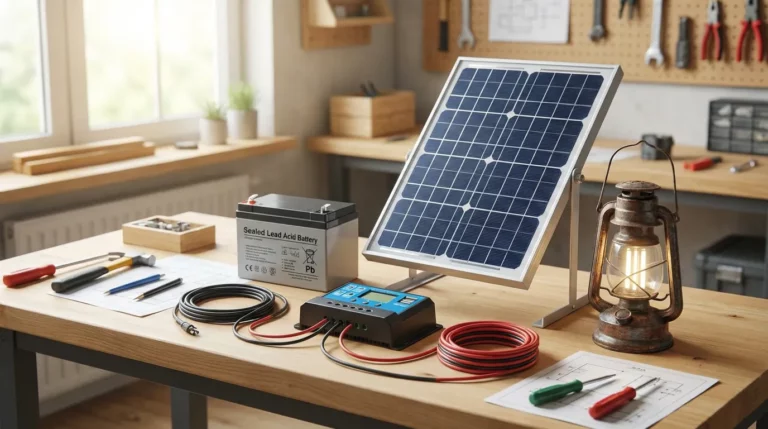
The Components You Need
| Component | What It Does | Recommended Product | Price |
|---|---|---|---|
| Solar panels | Generate DC power from sunlight | Renogy 100W Mono (x2–4) | ~$85/panel |
| Charge controller | Regulates charging to protect batteries | Victron 100/20 MPPT | ~$80 |
| Battery bank | Stores power for use when sun isn’t shining | Renogy 100Ah LFP 12V (x1–2) | ~$230/unit |
| Inverter | Converts 12V DC to 120V AC for household appliances | Renogy 1000W Pure Sine 12V | ~$130 |
| Wiring + fuses + connectors | Connects the system safely | MC4 connectors, 10AWG wire, ANL fuse | ~$50 |
200W system (2 panels + 100Ah LFP + inverter): ~$700–750 total
400W system (4 panels + 200Ah LFP + inverter): ~$1,100–1,200 total
Sizing Your System: The Math
Sizing a solar system isn’t difficult once you know your consumption. Here’s the process for a family of 4:
Step 1: List what you need to power and for how long.
- Mini fridge (100W × 24h × 30% duty cycle = 720Wh/day)
- LED lights, 4 rooms (10W × 5h = 200Wh/day)
- Phone charging, 4 phones (10W × 2h = 80Wh/day)
- Small fan (30W × 8h = 240Wh/day)
- Total: ~1,240Wh/day
Step 2: Size your solar array. In most US locations, solar panels produce usable power for 4–5 “peak sun hours” per day. Divide daily consumption by peak sun hours and add 25% buffer:
1,240Wh ÷ 4.5 hrs × 1.25 = ~345W of panels needed → 4 × 100W panels.
Step 3: Size your battery bank. You want 1–2 days of storage without sun. 1,240Wh/day × 1.5 days = 1,860Wh needed. A 12V 100Ah LFP battery holds 1,200Wh usable (100Ah × 12V = 1,200Wh at 100% DoD). Two batteries = 2,400Wh — adequate.
Battery Storage: The Heart of the System
Your battery bank is the most expensive and most critical component. Choosing the right chemistry affects how long the system lasts and how much usable capacity you actually get.
LFP (Lithium Iron Phosphate) vs. Lead-Acid
| Factor | LFP (Lithium Iron Phosphate) | AGM Lead-Acid |
|---|---|---|
| Usable capacity | 95–100% (can fully discharge) | 50% (must stay above 50% to preserve lifespan) |
| Lifespan | 3,000–5,000 cycles | 300–500 cycles |
| Weight (100Ah) | ~25 lbs | ~60 lbs |
| Maintenance | None | Occasional equalization charge |
| Cost (100Ah 12V) | ~$230–280 | ~$150–200 |
| Temperature tolerance | Good (no charging below 32°F without heat management) | Poor in cold (significant capacity loss) |
| Best for | Long-term prepper investment, cycling system | One-time emergency backup, budget-constrained |
The math strongly favors LFP for anyone building a real emergency power system. A 100Ah AGM at 50% usable depth gives you 600Wh. A 100Ah LFP at 95% usable gives you 1,140Wh — nearly double the usable energy from the same nominal capacity, at a premium that pays for itself within 2–3 years of use.
Recommended: Renogy Smart Lithium Iron Phosphate Battery 100Ah 12V (~$230) with integrated BMS. Pairs directly with Victron or Renogy MPPT charge controllers via Bluetooth monitoring.
Wind Energy: Only If Your Location Qualifies
Small wind turbines can supplement solar well — they produce power at night and on overcast days when solar output is reduced. The critical qualifier: your location needs a consistent average wind speed of at least 10–12 mph for small turbines to generate meaningful power.
How to check: WeatherUnderground or Windfinder.com show historical average wind speeds for your area. If your average is below 8–10 mph, a wind turbine will be a frustrating underperformer. More solar panels are almost always the better investment for most US suburban locations.
If your location qualifies:
- Pikasola 400W Wind Turbine (~$150): Entry-level DIY turbine. At 400W rated output (actual output depends heavily on wind speed). Pairs with a hybrid solar+wind charge controller.
- Windmill 1500W turbine (~$400): More capable unit for properties with good wind access. Produces measurable output starting at 7 mph.
Micro-Hydro: The Best Source Nobody Talks About
If your property has a stream or creek with consistent flow and at least 2–3 feet of elevation drop (head), a micro-hydro system is more valuable watt-for-watt than solar or wind. The reason: water flows 24 hours a day, 365 days a year, at consistent output. No batteries needed for continuous power.
A micro-hydro system producing just 300W continuous generates 7,200Wh per day — far more useful than a 400W solar array that averages 4–5 peak hours.
- PowerPal micro-hydro generator (~$2,000): Entry-level system for low-head (1–10 ft) installations. Ideal for small streams. Produces 1–10 watts depending on site conditions — excellent for continuous LED lighting and device charging.
- Harris Hydroelectric turbines (~$2,500+): Higher-output systems for sites with good head and flow. This is serious equipment with a 30+ year lifespan.
Micro-hydro is a significant investment and requires site assessment first. But if you have running water on your property, it’s the most reliable and lowest-maintenance renewable energy source available.
Common Mistakes
- Underestimating energy consumption. A standard refrigerator uses 1,000–1,500Wh per day. A chest freezer uses 200–400Wh/day. Many preppers design systems around the freezer but forget the fridge, HVAC fan, sump pump, or chest freezer. Add up everything before sizing.
- Buying cheap panels without checking the specs. Panel wattage ratings are measured under ideal lab conditions. Real-world output is 15–25% lower. Always buy from established brands (Renogy, Rich Solar, LG, Panasonic) with documented warranty and actual output curves.
- Using a PWM controller instead of MPPT. A PWM (pulse-width modulation) charge controller is cheaper but loses 20–30% of available solar energy. An MPPT (maximum power point tracking) controller like the Victron 100/20 (~$80) pays for itself in recovered energy within the first year of operation. Always use MPPT.
- Buying AGM batteries to save money. Short-term savings, long-term loss. AGM’s 300–500 cycle lifespan at 50% depth of discharge means you’ll replace them 5–10x before a single LFP bank needs replacement. Calculate total cost of ownership over 10 years.
- No surge protection or proper fusing. A solar system without proper fusing and grounding is a fire risk. Every connection between battery and load needs an appropriately-sized fuse. Battery to inverter: ANL fuse sized 25% above maximum inverter draw. Solar panels to controller: inline fuse on each positive lead.
FAQ
How much can a basic DIY solar system actually run for a family of 4?
A 400W solar array with 200Ah LFP battery bank (total system ~$1,100) generates approximately 1,400–1,600Wh on an average sunny day. That powers: LED lighting for all rooms (~200Wh), a small chest freezer running 24/7 (~350Wh), phone and device charging for 4 people (~80Wh), a 12V fan (~240Wh), and a radio (~30Wh) — with energy to spare. You won’t run an air conditioner or electric stove, but your food stays frozen, your family stays informed, and your devices stay charged indefinitely.
Do I need an electrician to install a DIY solar system?
For a basic 12V off-grid system (not connected to your home’s electrical panel), no. The system runs at 12V DC and the inverter output plugs into extension cords — no panel work required. If you want to connect to your home’s wiring through a subpanel or transfer switch, you’ll need a licensed electrician and a permit in most jurisdictions. The DIY 12V approach avoids this complexity entirely.
How many solar panels do I need to run a full-size refrigerator?
A standard refrigerator draws 100–150W and runs intermittently, consuming ~1,000–1,500Wh per day. To power it reliably through 4–5 peak sun hours plus overnight: 400W of solar panels (to account for efficiency losses and partial shade) + 200Ah LFP battery (to cover overnight and a cloudy day). Budget: ~$1,000 for the solar + battery system, not counting the inverter.
What’s the difference between a pure sine wave and modified sine wave inverter?
Always buy pure sine wave. Modified sine wave inverters are cheaper but cause problems with sensitive electronics (CPAP machines, medical devices, variable-speed motors, some chargers). They can damage equipment over time. Pure sine wave inverters cost $20–50 more but are compatible with everything. The Renogy 1000W Pure Sine (~$130) is the standard recommendation for a 12V prepper system.
Is solar worth it if I live in a cloudy climate?
Yes, but size up. Solar panels produce electricity from ambient light, not direct sun — they just produce less on cloudy days (typically 10–25% of rated output). In the Pacific Northwest or New England, plan for 3–4 peak sun hours average vs. 5–6 in the Southwest. Size your array accordingly: what requires 400W in Phoenix may require 600W in Seattle for the same daily output. Use PVWatts (pvwatts.nrel.gov, free NREL tool) to estimate actual output for your specific location and panel orientation.
Bottom Line: For most prepper families, the path is: start with an EcoFlow DELTA 2 (~$500) + 2 Renogy 100W panels (~$170) for immediate critical power, then build a permanent 400W/200Ah DIY 12V system (~$1,100) when budget allows to cover food security power. That two-stage investment under $2,000 gives you indefinite power for the essential functions of a 4-person household — lights, devices, food preservation, water pressure (12V pump), and communications — with zero ongoing fuel cost. The generator becomes a short-term bridge rather than a long-term dependency.

Dan Lockland is a preparedness instructor and survival skills educator with over 15 years of hands-on experience. He shares practical, no-nonsense guidance on emergency preparedness, self-reliance, and sustainable living at PreparingWithDan.com.