
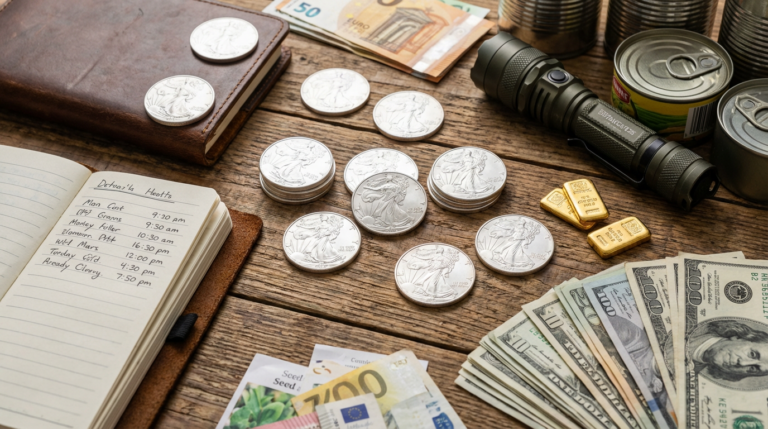
Every serious prepper secures food, water, and power. Very few secure their financial position with the same rigor. But in an economic crisis — hyperinflation, banking system disruption, or a prolonged collapse — cash in a bank account may be the least useful asset you have. The people who navigated Weimar Germany, Zimbabwe’s hyperinflation, and Venezuela’s economic collapse with their purchasing power intact weren’t the ones with savings accounts. They were the ones who held assets that maintained value independent of a government’s monetary decisions.
This isn’t about predicting collapse. It’s about applying the same layered redundancy to your financial situation that you apply to your food storage and communications. Here’s how to build that stack.
Why Cash Alone Is a Vulnerability
Cash has two failure modes that matter to preppers:
- Inflation/hyperinflation: When governments print large quantities of currency, existing cash loses purchasing power. Moderate inflation of 5–10% per year erodes savings steadily. Hyperinflation — which has happened in multiple countries in living memory — can destroy savings in weeks.
- Banking system disruption: In a financial crisis severe enough to threaten banks, access to your digital account balance is not guaranteed. Bank runs, capital controls, and temporary closures have occurred in modern economies within the last 30 years (Argentina 2001, Cyprus 2012, Greece 2015).
The prepper’s approach: hold a diversified position across assets that don’t all fail simultaneously. Cash has legitimate emergency value — physical cash outside the banking system survives bank closures. But it should be one layer, not the only layer.
Layer 1: Physical Precious Metals
Gold and silver have maintained purchasing power across thousands of years and multiple civilizational collapses. They are not dependent on any counterparty, any government’s promise, or any technological infrastructure. This makes them uniquely resilient against the failure modes that threaten paper currency.
Gold: Wealth Preservation in Compact Form
Gold’s primary function for preppers is preserving large amounts of wealth in a small, portable, durable form. One troy ounce of gold currently holds the equivalent purchasing power of roughly 500–600 gallons of gasoline — it has held comparable relative value for centuries. You’re not trying to profit; you’re trying to not lose.
- American Gold Eagle (1 oz): The standard US government-issued coin. Recognized everywhere, straightforward to buy and sell. Roughly $2,000–2,100 as of 2026 at major dealers. Smaller denominations (1/4 oz, 1/10 oz) are available for flexibility but carry higher premiums per ounce.
- American Gold Buffalo (1 oz): 24-karat (.9999 fine) versus the Eagle’s 22-karat (.9167). Slightly higher premium, preferred by some for higher purity.
- PAMP Suisse Gold Bars (1 oz, 10 oz): Bars carry lower premiums over spot than coins but may be slightly harder to sell to private parties who are unfamiliar with them. Good for larger positions.
Allocation guideline: Most financial advisors suggest 5–10% of investable assets in precious metals as a hedge. For preppers, that’s a floor, not a ceiling. Where you land depends on your risk assessment and other preps. Build toward 1–3 months of living expenses in gold before moving to larger amounts.
Silver: The Day-to-Day Exchange Metal
Silver is where gold is impractical. If you need to trade for a tank of gas or a bag of groceries in a disrupted economy, a $2,000 gold coin is wrong-sized. Silver at $28–35 per ounce provides denomination flexibility.
- American Silver Eagle (1 oz): The most recognized US silver coin. Easy to sell, widely understood. Current premium over spot is $5–8/oz at most dealers — higher than it used to be, but still the most liquid option.
- 90% Junk Silver (pre-1965 US dimes, quarters, half-dollars): Actual silver content in familiar coin form. Face value of $1 in pre-1965 coins contains approximately 0.715 oz silver. Many preppers prefer junk silver for small transactions because the denominations are intuitive.
- One-ounce silver rounds (privately minted): Lower premium than Eagles (~$2–3/oz over spot). Less recognized than Eagles but still tradeable. Good value per ounce for a silver position.
Storing Precious Metals
Physical storage requires physical security. Options:
- Home safe (bolted to floor or wall): Fire- and water-resistant safes in the 500–800 lb range are appropriate for modest positions. A cheap 40-lb safe is easily carried away. Look for TL-15 or TL-30 ratings for theft resistance. Liberty Safe and Fort Knox make quality options in the $800–2,000 range.
- Bank safety deposit box: Accessible during banking hours, FDIC-insured institution, low cost. Limitation: not accessible during a banking crisis or after-hours emergency.
- Diversified storage: Don’t keep everything in one place. Split your position between home storage and a bank box at minimum.
IRS reporting: dealers are not required to report single purchases of any amount. Sales may require reporting depending on amount and product type. American Eagles (both gold and silver) have the fewest reporting requirements. Consult a tax professional for your specific situation.
Layer 2: Cryptocurrency (With Caveats)
Cryptocurrency offers some genuine prepper value: it’s not subject to government seizure or inflation by any central authority, can be moved across borders digitally, and a hardware wallet with $1,000 in Bitcoin is more portable than equivalent gold. But it has critical failure modes that gold does not: it requires technological infrastructure (power, internet) to access and transfer, and its value is highly volatile.
For most preppers, cryptocurrency is a speculative hedge that belongs after physical metals, not before them.
- Bitcoin (BTC): The most established, most liquid, most widely accepted cryptocurrency. Fixed supply (21 million coins maximum). Has survived multiple 70–80% drawdowns and recovered. If you’re going to hold crypto long-term, Bitcoin is the most defensible choice.
- Monero (XMR): Privacy-focused cryptocurrency. Transactions are not traceable on the public ledger, unlike Bitcoin. Relevant if financial privacy is a priority in your threat model.
Hardware Wallets: Required for Meaningful Positions
Cryptocurrency held on an exchange (Coinbase, Kraken, etc.) is subject to exchange failure, hack, or regulatory seizure. The phrase in the crypto community is accurate: “not your keys, not your coins.” Any meaningful position should be held in a hardware wallet:
- Ledger Nano X (~$150): The most widely used hardware wallet. Stores private keys offline. Bluetooth enabled, supports 5,500+ cryptocurrencies. Write your seed phrase (12 or 24 words) on paper and store separately from the device — this is your recovery method.
- Trezor Model T (~$180): Open-source firmware, touchscreen, strong security reputation. Alternative to Ledger for users who prefer fully open-source solutions.
Layer 3: Bartering Assets
In a significant enough economic disruption, scarce consumables become currency. Cigarettes were currency in World War II POW camps. Vodka was a medium of exchange in the Soviet collapse. The principle: when formal currency fails, people trade for things they need.
Bartering assets to stockpile (beyond your own family’s use):
| Category | Specific Items | Why It Works |
|---|---|---|
| Food staples | Freeze-dried meals, rice, canned goods | Universal demand, high value when supply is disrupted |
| Alcohol | Liquor (bourbon, vodka — sealed, full bottles) | Extremely stable barter value historically; non-prepper families often lack it |
| Tobacco | Cigarettes, chewing tobacco, lighters | Addictive demand; historical record across multiple collapse scenarios |
| Medical supplies | Antibiotics (fish amoxicillin or prescribed), OTC pain relievers, wound care | Life-or-death demand when pharmacies are closed |
| Fuel | Propane, gasoline with stabilizer, firewood | Heating and cooking have no substitutes |
| Tools and repair | Multi-tools, duct tape, paracord, fasteners | Needed for maintenance when supply chains are broken |
| Hygiene | Soap, toothpaste, feminine hygiene products, toilet paper | Immediate quality-of-life demand; easy to stockpile |
Bartering skill matters as much as bartering inventory. Know what things are actually worth in your community. Understand negotiation. Don’t show your full inventory. Have a sense of what you genuinely need versus what you’d like to have — it makes you a better trader.
Layer 4: Physical Cash Outside the Banking System
A $1,000–2,000 cash reserve at home covers the gap between “normal” and “serious crisis.” ATMs stop working in power outages. Banks limit withdrawals during financial panics. Card systems fail when internet is down. Cash in your hand works for local transactions as long as merchants accept it.
Best denominations: mostly $20s and $50s (widely accepted and countable), some $5s and $10s (smaller transactions), some $1s (exact change, vending). Store in a fireproof/waterproof container. Don’t tell people you have a cash reserve.
Building Your Financial Prep Stack
| Priority | Asset | Target Amount | Why This Order |
|---|---|---|---|
| 1 | Physical cash at home | $1,000–2,000 | Covers immediate disruptions |
| 2 | Silver (junk coins or Eagles) | $500–2,000 face value | Flexible denomination, inflation hedge |
| 3 | Gold (1 oz Eagles) | 2–5 oz minimum | Large-value wealth preservation |
| 4 | Bartering inventory | $200–500 in targeted items | Works when metals may not |
| 5 | Cryptocurrency (optional) | 1–5% of investable assets max | Speculative, infrastructure-dependent |
Common Mistakes
- Buying numismatic (collector) coins instead of bullion. Numismatic premiums are based on rarity and condition, not metal value. In a crisis, nobody is paying numismatic premiums. Buy bullion — American Eagles, rounds, bars. Save the collector coins for a hobby, not a financial hedge.
- All metals, no liquidity. If your emergency financial position is 100% in gold and silver with no cash and no bartering goods, you can’t make change. Balance your position: cash for small transactions, silver for mid-range, gold for large value stores.
- Crypto on an exchange with no hardware wallet. Exchange risk is real. FTX went bankrupt in 2022, taking customer funds with it. If you’re holding crypto as a serious prepper asset, it needs to be in your hardware wallet, not on an exchange.
- No understanding of IRS reporting requirements. Gains from selling precious metals or cryptocurrency are taxable events. Failing to report creates legal risk. Keep records of your purchase prices. Consult a tax professional if you’re building a significant position.
- Telling people about your financial preps. OPSEC applies to your financial position as much as your food storage. The information that you hold significant physical gold at home is a security liability. Treat it accordingly.
FAQ
Is gold actually useful in an emergency?
Yes, but it depends on the type of emergency. In an economic collapse or hyperinflation scenario, gold has excellent historical performance — it held value through Weimar Germany, the 2008 financial crisis, and Venezuela’s hyperinflation. In a localized natural disaster lasting a few days, gold is mostly irrelevant — cash and prepper supplies matter more. Gold is a multi-month to multi-year hedge, not a 72-hour emergency tool.
How do I buy precious metals without getting ripped off?
Know the spot price before you buy (kitco.com, goldprice.org). Reputable dealers charge a premium over spot — that’s normal and expected. For silver, expect $3–8/oz over spot for Eagles, $2–4 for rounds and junk silver. For gold, expect $50–100/oz over spot. Avoid infomercial dealers, TV coin ads, and anyone charging more than 10% over spot for standard bullion products. JM Bullion, APMEX, and Provident Metals are well-regarded online dealers with transparent pricing.
Should I tell my family about my financial preps?
Yes, to the people in your household who need to know where it is in an emergency — and no to everyone else. Family members need to know where the safe is, how to access it, and roughly what’s in it. Extended family, friends, neighbors, and acquaintances do not. This is standard OPSEC applied to wealth storage, not paranoia.
How much silver do I actually need for bartering?
A common starting point: $500–1,000 face value in 90% junk silver (pre-1965 dimes, quarters, and half-dollars). This gives you many small-denomination trade units. For context, $100 face value in junk silver contains about 71.5 oz of silver — worth approximately $2,000–2,500 at current prices. That’s meaningful transaction capability without overcommitting to metals over other preps.
What happens to my Bitcoin if the internet is down?
You can’t access or transfer it without internet connectivity. Your private keys (on the hardware wallet) still control the coins — they still exist on the blockchain — but you can’t do anything with them until connectivity is restored. This is why crypto is at the bottom of the financial prep stack for most preppers, not the top. Gold doesn’t need the internet.
Bottom Line: The financial prep stack for a prepper family goes in order: $1,000–2,000 in physical cash at home, then silver (junk coins or Eagles) for flexible-denomination inflation hedging, then gold (1 oz Eagles) for large-value wealth preservation, then bartering inventory targeting the consumables most likely to be in demand. Cryptocurrency is optional and goes last. Total cost to reach a meaningful financial hedge: $3,000–8,000 in metals plus a modest bartering stockpile built gradually alongside your other preps.
