
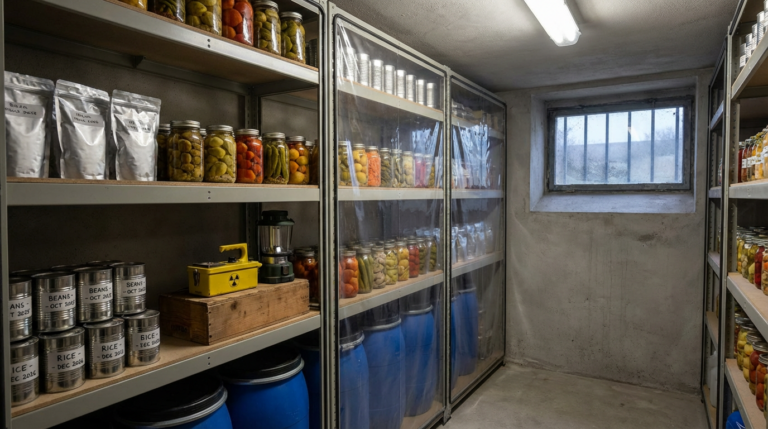
The food safety rules for nuclear fallout are different from what most people assume, and getting them wrong in either direction creates real problems: eating contaminated food causes internal radiation exposure, but throwing out perfectly safe food during a shelter period leaves your family without supplies when supply chains are disrupted. The key distinction is between external contamination (radioactive particles settling on surfaces) and internal contamination (radiation getting into your body through ingestion). Most of your existing food supply is safer than you think. Most fresh produce outside during a fallout event is riskier than you think.
This guide covers the specific rules for a family of 4 sheltering during and after a nuclear fallout event: what food is safe, what is not, how to handle your existing supply, and what you should have stored in advance.
What Nuclear Fallout Actually Does to Food
Radioactive fallout consists of particles — dust and debris that has been made radioactive by a nuclear detonation or reactor release. These particles settle on surfaces, including food, water, and soil. The key facts:
- External contamination means particles are on the surface of food. For most packaged foods, the packaging blocks this entirely. For produce, washing often removes most particles. The risk is consuming those particles.
- Internal contamination is what you are actually trying to prevent — ingesting or inhaling radioactive particles, which then irradiate tissue from inside your body. This is the pathway that causes acute radiation syndrome.
- Absorbed contamination is more complex: plants absorb radioactive iodine-131, cesium-137, and strontium-90 through soil and rainwater. This contamination cannot be washed off because it is inside the plant tissue. This is why fresh produce from affected areas is dangerous even after washing.
- Decay: Iodine-131 has a half-life of 8 days, meaning its activity halves every 8 days. After 80 days, it is essentially gone. Cesium-137 has a 30-year half-life — it persists in soil for decades and is why contamination zones from Chernobyl are still restricted 40 years later.
What Food Is Safe: A Practical Decision Framework
| Food Type | Safety Status | Action Required |
|---|---|---|
| Canned goods (sealed) | Safe | Wipe exterior before opening; contamination is on the can, not inside |
| Commercially packaged dry goods (sealed) | Safe | Wipe exterior if dusty from fallout |
| Home-canned food (sealed before event) | Safe | Inspect seal; if intact and properly sealed, contents are safe |
| Frozen food (power maintained) | Safe | Normal food safety rules apply |
| Garden produce (not yet contaminated) | Safe | Harvest and bring inside before fallout arrives if possible |
| Garden produce (exposed during fallout) | Risky — assess | Surface-contaminated: wash thoroughly. Root vegetables: remove outer layer and wash. Leafy greens and fruits: significant risk from absorbed contamination, avoid until official guidance |
| Fresh produce from market (pre-event) | Safe | Normal washing |
| Municipal tap water | Usually safe short-term | Water treatment plants continue to filter; follow official guidance on local water supply |
| Well water | Variable | Shallow wells contaminated by surface runoff; deep wells generally safer; test if possible |
| Open water sources (lakes, rivers, collected rainwater during fallout) | Unsafe | Do not use without filtration and treatment; fallout settles in open water |
| Milk from cows grazing outdoors | Unsafe for weeks | Cows eating contaminated grass produce milk with radioactive iodine; avoid fresh milk for 60+ days post-event |
| Packaged UHT milk (ultra-high temperature pasteurized) | Safe | Sealed before event; safe to consume |
Water Safety in a Fallout Scenario
Water is more complex than food. Your body needs 1 gallon per person per day minimum — for a family of 4, that is 28 gallons for a one-week shelter period. Here is how to assess your water supply:
Municipal Water
Municipal water treatment plants with their covered reservoirs and filtration systems are generally safe during fallout events. Filters and sedimentation remove most particulate contamination. Follow official guidance from your local water authority. If they issue a boil order, follow it; if they do not, municipal water is generally safe to continue using.
Stored Water
Pre-stored water in sealed containers is completely safe regardless of what happens outside. This is why storing water before an emergency is so important. Food-grade water storage containers filled from a municipal source before the event are unaffected by fallout.
Well Water
Deep drilled wells (100+ feet) are generally safe from fallout contamination because the aquifer is not directly connected to surface runoff. Shallow wells (under 50 feet, dug wells) are at higher risk from surface water infiltration. If you are on a shallow well, pre-fill containers from the tap before a fallout event if you have warning. After the event, have the water tested before continuing use if there is any question about contamination.
Improvised Water Treatment After Fallout
If you must use water from an outdoor source after fallout, the treatment is different from standard water purification for biological contamination. Radioactive particles behave like sediment — you can remove most of them through:
- Allow to settle: Let water sit undisturbed for 24 hours. Most particles will settle to the bottom.
- Careful decanting: Pour the top 2/3 of the water into a new container, leaving the settled sediment behind.
- Filter through cloth or sand: Multiple layers of cloth or a sand/gravel filter removes additional particles. Not as effective as commercial filters but meaningful.
- Boil or treat: Standard disinfection for biological contamination as a second step.
Note: Standard water filters (Brita, etc.) are NOT effective at removing dissolved radioactive isotopes like cesium or iodine. They remove particles but not dissolved ions. For dissolved contamination, reverse osmosis or ion exchange systems are needed. This is why pre-stored water and sealed municipal water are so much more practical than trying to filter contaminated sources.
What to Have Stored: The 2-Week Family of 4 Food Plan
FEMA recommends 2 weeks of food and water for nuclear preparedness, consistent with the shelter-in-place period needed for most fallout scenarios. For a family of 4 consuming approximately 8,000 calories per day total:
| Item | Quantity for 2 Weeks | Approx. Cost | Notes |
|---|---|---|---|
| Water | 56+ gallons (7 gal/day × 4 people × 2 weeks) | $20–$40 in storage containers | WaterBOB bathtub bladder (100 gal, $30) or 5-gal food-grade jugs |
| White rice (bulk) | 40 lbs | $25–$40 | 500+ cal/cup cooked; stores 20+ years in sealed bucket |
| Dried beans/lentils | 20 lbs | $20–$35 | High protein + fiber; requires cooking with stored water |
| Canned proteins (tuna, chicken, salmon) | 30–40 cans | $60–$90 | No cooking required; high protein; rotate annually |
| Canned vegetables | 30–40 cans | $30–$50 | Corn, green beans, tomatoes; vitamins during extended shelter |
| Peanut butter | 8–10 lbs (4–5 large jars) | $30–$40 | Calorie-dense (190 cal/2 tbsp), no cooking, good fats and protein |
| Crackers / hardtack | 5–8 lbs | $15–$25 | Ready-to-eat vehicle for peanut butter and canned goods |
| Oats (rolled) | 10–15 lbs | $10–$20 | Breakfast; high fiber; 300 cal/cup cooked |
| UHT milk or powdered milk | 2–3 gallons equivalent | $15–$25 | Calcium and calories; UHT shelf-stable for 6–9 months |
| Honey | 2–3 lbs | $10–$15 | Indefinite shelf life; calorie-dense; morale |
| Multivitamins | 120–180 tablets (60-day supply) | $10–$20 | Covers micronutrient gaps in canned/dry food diet |
Total budget estimate: $215–$360 for a 2-week food supply for 4 people. This is a one-time investment that rotates over time as you use and replace items.
Handling Your Existing Food Supply When Fallout Occurs
When you receive a fallout warning and shelter in place, take these steps with your existing food supply:
- Immediately bring in any food from outside (garden produce, BBQ food, items on the porch) before fallout arrives, if you have any warning.
- Inventory what you have sealed and protected: Everything in original, sealed packaging is safe. Move it to your shelter area.
- Open containers: Food in open bowls, uncovered pots, or open bags in the kitchen should be covered or sealed if fallout may have entered the building before you sealed it. When in doubt, cover and assess later.
- Pre-fill every container with water from the tap immediately when the alert comes — bathtubs, pots, jugs. Municipal water is safe; get as much of it stored as you can before any disruption to the water system.
- Do not go outside to garden, forage, or get more supplies during the active fallout period. The first 24–48 hours have the highest radiation levels; this is when outdoor exposure is most dangerous.
After the Shelter Period: Returning to Normal Food Sources
After the declared all-clear or recommended shelter period, the contamination picture shifts:
- Commercially packaged food from stores: Safe, assuming the store building was intact during fallout.
- Garden vegetables: Follow official local guidance. In general, root vegetables (carrots, potatoes, beets) grown in potentially contaminated soil should be peeled and washed. Leafy greens and fruits that were outdoors during fallout should be assessed by local health authorities before consumption.
- Meat from animals that were grazing outdoors: Wait for official guidance. Animals that ate contaminated grass accumulate radioactive iodine.
- Fresh milk: Follow official guidance; avoid fresh local milk for at least 60 days after a nuclear event involving radioactive iodine release from a reactor.
- Fish from local waterways: Avoid consuming local fish for months to years after a significant detonation near waterways — aquatic ecosystems accumulate radioactive contamination.
Common Mistakes in Nuclear Fallout Food Preparation
1. Assuming all food needs to be discarded after a fallout event
This leads families to discard safe sealed food unnecessarily, then have nothing to eat during a shelter period. Most packaged food in your home is unaffected by external fallout contamination. Throw out exposed food; keep sealed food. The distinction matters.
2. Storing only calorie sources without considering cooking requirements
Rice and dried beans are excellent long-term storage staples, but both require 20–45 minutes of cooking time and significant water. During a nuclear shelter-in-place with power out and limited water, this creates a practical problem. Include ready-to-eat foods (canned goods, peanut butter, crackers, hard cheese) that require no cooking, no additional water, and no preparation. Aim for 50% of your stored calories to be fully ready-to-eat.
3. Not storing enough water
Most emergency food plans vastly underestimate water needs. Cooking dried beans and rice requires 2 cups of water per cup of dry food. Drinking minimum of 0.5 gallons per person per day. Hygiene needs more. Plan for 1.5–2 gallons per person per day for a realistic 2-week shelter. For a family of 4, that is 84–112 gallons — far more than most families have stored.
4. Eating garden produce contaminated during fallout without proper assessment
The desire to use fresh food from your own garden is understandable but risky. Produce that was outdoors during a fallout event requires decontamination for surface contamination at minimum, and assessment for absorbed contamination before eating. Follow local public health guidance, which will be specific to your area based on measured contamination levels.
5. Assuming bottled water is safe if it was outdoors during fallout
Sealed plastic water bottles are safe — the plastic provides a barrier. But if bottles were outside, wipe them down before handling (to avoid transferring surface contamination to your hands and then to your food). Open the bottle only after wiping the cap area. The water inside is safe; the outside surface may not be.
FAQ
How do I clean canned goods that may have been exposed to fallout?
Wipe the exterior of the can with a damp cloth before opening. Discard the cloth or rinse your hands after handling. Open the can, discard the lid, and the contents are safe to consume — the metal can fully blocks external contamination. The inside of a sealed can is unaffected by fallout. This cleaning step is quick and provides a meaningful safety margin at no cost.
Is it safe to drink tap water during a nuclear fallout event?
Generally yes for municipal water, assuming the water utility is operating normally. Municipal treatment systems filter out particles. The main concern is radioactive iodine-131, which passes through standard filters. Official guidance from your local water authority will address this specifically. If in doubt, use pre-stored water during the first 48 hours and wait for official statements on municipal water safety. Pre-filling containers from the tap immediately when an alert comes gives you buffer stock while you await official guidance.
When is it safe to eat food from my garden after a nuclear fallout?
This depends on how close you are to the source, wind patterns, measured contamination levels in your area, and what type of nuclear event occurred. Local public health authorities will issue guidance specific to your area based on actual measurements. As a general rule: root vegetables can often be decontaminated by peeling and washing; leafy greens and fruit that were exposed outdoors require official assessment before eating; produce that was inside or covered during the fallout event is much safer. Do not eat food grown in soil in a designated contamination zone without official clearance.
How long does food in my pantry remain safe after a nuclear fallout?
Sealed food in your pantry has a shelf life determined by its packaging and contents — not by the fallout event. Canned goods sealed before the event are as safe six months later as the day you bought them. The fallout did not contaminate them if they were sealed. What changes is that fresh food from outdoor sources (produce, meat, dairy) may be contaminated for months to years depending on proximity to the event. Your pantry supply — properly rotated — is what sustains your family during that transition period.
Bottom Line
Food safety during nuclear fallout comes down to one principle: sealed before the event is safe; exposed to fallout particles requires assessment. The practical preparation is straightforward: store 2 weeks of sealed, non-perishable food and water for your family now. When an event occurs, shelter in place with your stored supply, follow official guidance on local water and fresh food, and wait for the all-clear before resuming normal food sourcing.
The families who struggle are the ones who have nothing stored and must either forage in a contaminated environment or go without. The preparation cost for 2 weeks of food and water is $200–$400 and an afternoon of shopping. Do it before you need it.
