
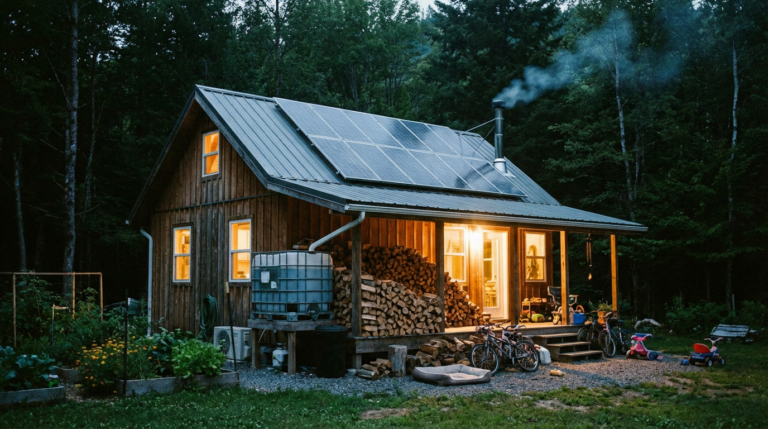
Off-grid living with kids is doable — but it’s not cheap, not simple, and not for every family. After reviewing dozens of real family transitions, here’s what separates those who thrive from those who quit after 18 months: planning around real numbers, not ideals. This guide covers startup costs, water and land requirements for a family of 4, and the mistakes that catch most first-timers off guard.
Table of Contents
- What Does It Actually Cost to Go Off-Grid With a Family?
- How Much Land and Water Does a Family of 4 Need?
- How to Power Your Off-Grid Home
- Feeding a Family of 4 Off-Grid: What’s Realistic
- Kids, Schooling, and Staying Connected
- Common Mistakes Off-Grid Families Make in Year One
- FAQ
Why Off-Grid Preparedness Matters Now
FEMA reports that most American families have less than 72 hours of supplies on hand. Families who’ve transitioned to off-grid living flip that equation — they’re prepared by default. But the first year is where most people fail, not because off-grid living is impossible, but because they planned around best-case scenarios instead of real ones.
The families who make it work share one trait: they tested their systems before they needed them.
What Does It Actually Cost to Go Off-Grid With a Family?
Most blog posts bury this number. A realistic off-grid setup for a family of 4 runs between $30,000 and $80,000 for year one — depending on whether you’re building new, converting existing property, or buying land that already has infrastructure. Here’s a realistic budget breakdown:
| System | Budget Setup | Mid-Range | Full Build |
|---|---|---|---|
| Solar energy (5kW system) | $8,000 | $15,000 | $25,000 |
| Water (well + filtration) | $3,000 | $7,500 | $12,000 |
| Rainwater harvesting backup | $800 | $2,000 | $4,500 |
| Composting/septic system | $1,500 | $4,000 | $8,000 |
| Food production (garden + tools) | $1,200 | $3,500 | $7,000 |
| Emergency fund (first year) | $3,000 | $5,000 | $8,000 |
| Estimated Total | $17,500 | $37,000 | $64,500 |
These figures don’t include land purchase or home construction. They assume you’re converting or setting up systems on existing property.
How Much Land and Water Does a Family of 4 Actually Need?
Water is where most families miscalculate — badly. Here’s the math for a family of 4:
- Drinking and cooking: 1 gallon per person per day = 4 gallons/day minimum
- Hygiene (conservative): 5 gallons per person = 20 gallons/day
- Small kitchen garden (200 sq ft): 30–50 gallons/day in dry season
- Livestock (2 goats, 6 chickens): 8–12 gallons/day
- Realistic daily total: 60–90 gallons/day minimum
A standard rainwater collection system (1,500 sq ft roof) in a region with 30 inches of annual rainfall yields roughly 28,000 gallons per year — about 76 gallons per day on average. That’s enough if you’re disciplined, but it leaves zero margin in a dry summer.
I’d strongly recommend pairing rainwater collection with a drilled well. The redundancy isn’t a luxury — it’s what keeps your family safe during the two months when it doesn’t rain.
For land size: a family of 4 aiming for 50–70% food self-sufficiency needs roughly 1–2 acres of usable growing space. That doesn’t mean you need a 10-acre property — it means you need 1–2 acres that aren’t forest, rock, or slope.
How to Power Your Off-Grid Home
Solar is the default choice for most families — and for good reason. A 5kW solar array with a 10kWh battery bank covers a disciplined family of 4’s daily needs in most US climates. Here’s how the main options compare:
| Energy Source | Best For | Upfront Cost | Reliability |
|---|---|---|---|
| Solar panels + battery | Most families, most climates | $$$$ | High (with battery backup) |
| Wind turbine | Open land, consistently windy areas | $$$ | Variable (wind-dependent) |
| Micro-hydro | Properties with a year-round stream | $$$ | Very high (constant output) |
| Propane generator | Backup only | $ | High, but fuel-dependent |
Most families end up with a primary system (usually solar) plus a propane generator as backup for 3–5 cloudy days in a row. Don’t skip the generator. That’s when kids get cold and parents get stressed.
Feeding a Family of 4 Off-Grid: What’s Realistic
Full food self-sufficiency is a 3–5 year project, not a year-one goal. Here’s what’s realistic to expect at each stage:
Year 1: A 400–600 sq ft kitchen garden covering roughly 15–20% of your produce needs. Tomatoes, zucchini, greens, and root vegetables are the highest-yield starting crops for a family of 4.
Year 2–3: Add fruit trees, perennials, and small livestock. Chickens (6 hens) give a family of 4 roughly 4–5 eggs per day. Two Nigerian Dwarf goats produce 1–2 quarts of milk daily — enough for drinking and cheese.
Always: Keep 90 days of freeze-dried or canned food in storage. Your garden will have bad years. Your livestock will get sick. Your storage is what keeps this from being a crisis.
Kids, Schooling, and Staying Connected
This is the question I get most from parents considering the switch: what about the kids?
Homeschooling is the most common path, and off-grid living actually makes it easier in some ways — kids are surrounded by real-world applications of math, biology, and engineering every day. Measuring garden yields, calculating solar panel output, tracking weather patterns: these aren’t school exercises, they’re daily life.
What’s harder: social development, especially for kids ages 8–14. The families that handle this best are intentional about it — weekly co-op groups, sports leagues in town, and regular visits to friends. Isolation is a choice, not a requirement of off-grid life.
For connectivity: a Starlink satellite connection runs about $120/month and gives reliable high-speed internet almost anywhere in the continental US. At that price, there’s no reason to be cut off from telehealth, online learning, or emergency alerts.
Common Mistakes Off-Grid Families Make in Year One
- Underestimating daily water use. Families consistently estimate they use 20–30 gallons per day. The real number is usually 60–90. Audit your actual use before you design your water system.
- Building the house before testing the systems. Drill the well, install the solar, and collect water for 60 days before you break ground on the house. Fix the problems when you still have a backup.
- No 90-day food buffer. The first garden fails more often than it succeeds. The first livestock get sick. Without stored food, a bad growing season becomes a genuine emergency for your family.
- Choosing land for the view, not the resources. Beautiful ridge-top property often has poor soil, limited water access, and no sun in winter due to surrounding trees. Buy the land that works, not the land that photographs well.
- Doing it alone. Off-grid families that plug into a community — even a loose network of nearby homesteaders — survive year one at much higher rates. Someone who’s already drilled a well in your county, navigated your county’s permit office, or dealt with the same soil type is worth more than any book.
FAQ
How much does it cost to go off-grid with a family of 4?
Realistically, $30,000–$80,000 for year one, covering solar, water systems, food production setup, and a backup generator. This doesn’t include land purchase or home construction. Most families overspend by 20–30% due to permits, troubleshooting, and equipment they didn’t anticipate needing.
How much land does a family need to live off-grid?
For 50–70% food self-sufficiency, plan for 1–2 acres of usable growing space. Total property size matters less than having enough flat, arable land with good sun exposure and reliable water access. A 5-acre property with 1 good acre beats a 20-acre property where nothing grows.
Can kids really thrive in an off-grid setting?
Yes — but it requires intentional effort around socialization. Homeschooling works well, especially when paired with co-ops, sports, and regular social activities in town. The families that struggle are the ones who move to a remote area without planning for their kids’ need for peers and structured activities.
How long before a family can be fully food self-sufficient off-grid?
Three to five years is realistic for 70–80% self-sufficiency. Year one: a productive kitchen garden. Years 2–3: fruit trees, small livestock, food preservation skills. Always maintain 90 days of stored food as a buffer — off-grid living has good years and bad years, and your storage is the difference.
What’s the biggest thing families underestimate about off-grid living?
Daily water use. Most families guess 20–30 gallons per day. The real number with a garden and basic livestock is 60–100 gallons. Design your water system around your worst-case dry month, not your best-case wet month — and always have two independent water sources.
The Bottom Line
Off-grid family living works — but it rewards families who plan with real numbers and punishes those who plan with best-case scenarios. Get your water system right, keep 90 days of food in storage, and build your community before you need it. For more on powering your home through any emergency, see Solar vs Gas Generator for Preppers — it’s the first decision most off-grid families get wrong.
Last Updated: April 2026
