
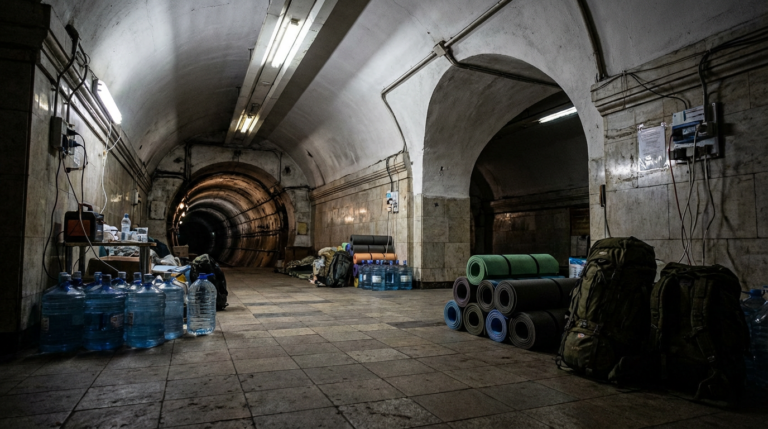
Underground spaces — subways, tunnels, parking garages, underground malls — amplify every threat that exists above ground. Explosions cause secondary collapses. Chemical agents concentrate in enclosed spaces. Crowd panic in narrow tunnels kills people who weren’t in any immediate danger from the original threat. And exits — the thing you need most — are limited, fixed, and often unfamiliar.
Real events make this concrete: the 2005 London 7/7 bombings, the 1995 Tokyo sarin attacks, the 2017 St. Petersburg metro bombing. In each case, survival outcomes correlated strongly with two variables: knowing exit locations before the emergency, and not joining the crowd crush in the minutes immediately after the event. This guide gives you the protocol — not vague advice about “staying calm,” but specific decisions for specific scenarios.
Part 1: Before the Emergency — Build Your Situational Baseline
Situational awareness isn’t paranoia — it’s the practice of noting facts about your environment before you need them. In a subway, it takes about 90 seconds and significantly improves your outcomes if something happens.
The 4-Point Entry Scan
When you enter any underground space, quickly note four things:
- Exit count and direction: How many exits does this station have? Which direction are they? The rule I use: count exits at every station you enter, even when you’ve been there before. It becomes automatic.
- Your position relative to exits: Are you closer to the front or rear of the platform? Which car of the train would put you nearest an exit at your destination?
- Uncrowded paths: Where would the crowd go in an emergency? Note the route in the opposite direction — it may be emptier and faster.
- Anything unusual: Unattended bags, people behaving with unusual agitation, strange smells, unusually rapid crowd movement. Most of these will be nothing. The practice of noticing costs nothing.
Carry the Right Gear
If you regularly use subways, these items in your everyday bag or on your person materially improve your options:
- Small flashlight (or phone with bright flashlight): Subway lights fail in explosions and power outages — darkness combined with smoke is the primary cause of post-blast fatalities
- N95 or P100 respirator: Folds flat in a jacket pocket; provides meaningful protection against smoke and some chemical agents during evacuation
- Basic first aid items: A folded tourniquet (CAT tourniquet) and a wound dressing take 2 oz of space; subway attacks most commonly cause blast injuries and shrapnel wounds
- Fully charged phone: After an event, cell networks jam quickly — send texts before voice calls (texts get through when calls don’t)
Part 2: The First 10 Seconds — Decision Framework
When something happens in an underground space, you have approximately 10 seconds before crowd behavior takes over and your options narrow. The decision tree is simple:
| What You Observe | Primary Action | Secondary Action |
|---|---|---|
| Gunshots / armed attacker | Move away from the sound immediately — don’t look | Run to exit; if trapped, find cover behind structural columns/concrete walls |
| Explosion / blast | Drop flat — secondary blasts are common; avoid windows and structural edges | Once shaking stops, assess injury, move toward exit against crowd flow if possible |
| Smoke / fire | Get low immediately — toxic smoke rises; stay below 2 feet if possible | Navigate to exit by wall-touch; move upwind or toward fresh air flow |
| Strange smell / people collapsing | Chemical agent — hold breath, cover face, move immediately toward fresh air | Evacuate without stopping to help until you are in fresh air; chemical agents incapacitate rescuers first |
| Sudden crowd surge/panic | Do not fight the initial crowd — move with it while angling toward the wall | Once at the wall, use it as a guide; slow movement against a wall is safer than crowd center |
Part 3: Scenario-Specific Protocols
Active Shooter in a Subway Station or Train
Run-Hide-Fight applies underground, with important modifications:
Run: Move immediately away from gunfire — toward the far end of the platform, through a connecting passage, or out an emergency exit. Don’t wait to confirm what you heard. Don’t stop to help others until you are clear. In a train, move through connecting doors to cars away from the shooter. Trains are long — distance is your friend.
Hide: Structural concrete columns, thick concrete walls, and steel support beams can stop or deflect rounds. Metal benches, trash cans, and glass panels cannot. The platform walls and support pillars at stations are your best ballistic cover. Get behind them and stay low.
Fight: This is your last resort, and only if you are directly threatened with no escape option. If multiple people coordinate simultaneously, a single attacker can be overwhelmed. This decision belongs entirely to the individual in the moment — no protocol can make it for you.
Explosion or Blast
Explosions in enclosed underground spaces produce multiple threat mechanisms simultaneously: the primary blast, secondary fragments (shrapnel), structural debris, and fire from ruptured fuel or electrical systems.
Immediately after the blast:
- Drop flat — secondary explosions are a documented tactic in multiple attack incidents
- Stay down for 10–15 seconds, shielding your head with your arms and bag
- Check yourself for injury — adrenaline masks pain; you may be injured without knowing it
- Turn on your flashlight — power will likely be out
- Move low along a wall toward the exit, staying below smoke level
Chemical or Gas Attack
This is the scenario with the highest lethality risk in underground spaces because chemical agents concentrate rapidly in enclosed environments. The 1995 Tokyo sarin attack killed 12 people and injured nearly 5,000 — in a system where the nerve agent exposure was actually quite limited. The injuries were so numerous because people didn’t recognize the signs and stayed in the environment.
Signs of a chemical agent release:
- Unusual smell (sarin has very faint odor; chlorine smells like pool water; mustard gas smells like garlic or mustard)
- Other passengers suddenly collapsing, convulsing, or having trouble breathing
- Visible mist or spray with no apparent cause
- Burning sensation in eyes, nose, or throat
Response (execute immediately, without waiting for confirmation):
- Take a deep breath and hold it
- Cover your nose and mouth with any fabric — even a dry cloth reduces exposure in the short term
- An N95 respirator provides meaningful protection against particulate agents and some aerosols
- Move immediately and rapidly toward fresh air — outdoor exits, not deeper underground
- Once outside: remove outer clothing (80% of chemical agent residue is on surface clothing), move upwind from the exit, do not re-enter
- Get decontaminated — find emergency responders, use any available water to flush skin and eyes
Part 4: Getting Out — Subway Evacuation Protocols
Crowd Management in Narrow Passages
Crowd crushes are responsible for more deaths in mass casualty events than the events themselves. In 2021, the Astroworld crowd crush killed 10 people — most from compressive asphyxia, not trampling. Underground passages concentrate exactly these conditions.
If you find yourself in a crowd surge:
- Keep arms bent at chest level — protect your ribcage and maintain an air pocket
- Do not grab onto handrails or fixed objects — the crowd will push you into them
- Move with the crowd at the crowd’s pace while angling diagonally toward the nearest wall
- If you fall: curl in a fetal position, protect your head, and try to get a knee under you to rise — don’t spread flat
- Avoid bottleneck points (narrow doorways, turnstile banks) — wait for the surge to thin, or find alternative exit
Navigating Smoke and Low Visibility
Get low. Toxic smoke from underground fires rises — the breathable air within 12–18 inches of the floor can buy you minutes of consciousness versus seconds at standing height. Use the wall as your navigation guide — keep one hand on the wall, stay low, move toward airflow (cooler air moving past you means you’re going toward fresh air).
Part 5: With Your Family — Group Protocols
Managing a family group in an underground emergency requires different protocols than solo survival. Children, elderly family members, and anyone with mobility limitations fundamentally change your decision calculus.
Establish Pre-Agreements Before Entering
Every time you take a subway trip with your family, take 30 seconds to establish:
- Rally point: “If we get separated, meet at the street exit on the north side.” Specific, not vague.
- Child instruction: Train your children to hold the back of an adult’s belt or backpack, not their hand — hand-holding fails in crowd pressure. Practice this at home.
- Contact protocol: Older children (12+) should have an out-of-area family contact memorized, not just in their phone
Moving as a Group
- Youngest/smallest members go in the middle of the group — adults on the outside
- Designate the strongest adult as a “blocker” at the rear who keeps the group from being separated by crowd flow
- Use linked hands only in low-crowd situations — switch to belt-grab in any high-density crowd
- Pre-assign an older child or teen to stay with younger siblings specifically — clear role, clear accountability
Common Mistakes in Underground Emergency Situations
1. Running toward the blast source to see what happened
Human instinct draws us to look toward loud noises and confusion. In a blast event, the source location is exactly where secondary blasts, structural collapse, and fire risk are highest. Move away from the source immediately, without looking.
2. Assuming the first exit you see is the best option
The most obvious exit is where the entire crowd will go. In a crush event, that exit becomes a compression point. If you know the station layout, a secondary or less-traveled exit may be faster and safer. This is why learning exit locations before you need them matters.
3. Stopping to film or document the event
The urge to use a phone as a camera in an emergency is well-documented and well-fatal. Your phone’s job in these first minutes is to get you out, not document anything. Use it for light. Use it to text your location to a contact. Don’t stop moving.
4. Not covering your airways in a smoke situation
A shirt held over the mouth and nose, even dry fabric, provides meaningful short-term filtration. It won’t filter toxic gases, but it reduces particle inhalation significantly during smoke evacuation. Do this automatically whenever you see smoke.
5. Following the crowd without any independent assessment
Crowds in emergencies often go in the wrong direction — toward the threat, into dead ends, against emergency personnel. Your pre-scan of exit locations means you have independent information that the crowd doesn’t. Trust that scan. Don’t follow blindly.
FAQ
What are the most dangerous aspects of an underground emergency?
In order of fatality risk in documented subway incidents: (1) crowd crush in narrow evacuation passages, (2) smoke and toxic gas inhalation from secondary fires, (3) secondary blast injuries from follow-on explosions, (4) direct attack injuries. Most people focus on the last item and prepare least for the first three, which historically kill more people.
Does an N95 mask actually help in a chemical attack?
An N95 masks provides significant protection against particulate chemical agents (biological, radiological aerosols) and reduces exposure to some chemical agents in aerosol form. It provides minimal protection against true vapor-phase agents like sarin. However, any barrier between your airways and a contaminated environment is better than none in the seconds it takes to reach fresh air. A P100 half-face respirator with cartridges provides substantially better protection for someone who regularly uses subways in high-risk environments.
What should I do if I’m on a train in a tunnel and something happens?
Stay on the train if it’s still moving — a moving train is heading toward a station and a proper evacuation point. If the train stops in a tunnel: check for smoke/fire/chemical smell (these change the calculus); otherwise wait for official instructions, as emergency services will typically move the train or send help. If you must self-evacuate in a tunnel, exit through the front or rear door ends, stay to the side of the tracks, identify the third rail and avoid it, and move toward the nearest station. Never touch the third rail — it carries 600–750V DC and kills instantly.
How do I keep children calm in a subway emergency?
Children who have been briefed in advance (in age-appropriate terms) perform better than children who are surprised. Make it a habit to tell kids the exit direction when you enter a subway — “those stairs go up to the street” takes five seconds and gives a child information that matters. During an event, give children a specific physical task (hold my belt, stay low, move fast) rather than general instructions (stay calm). Specific actions reduce panic more effectively than reassurances.
Bottom Line
Surviving a subway emergency is primarily a function of decisions made before the emergency — knowing where exits are, having minimal gear (flashlight, respirator), and having established family protocols. The people who survive these events aren’t special or faster or braver. They’re the ones who had already mentally walked through the scenario once, so when it happened, they had a plan instead of a blank.
Next time you take the subway, note the exits. That 10-second investment is the most actionable thing in this guide.
