
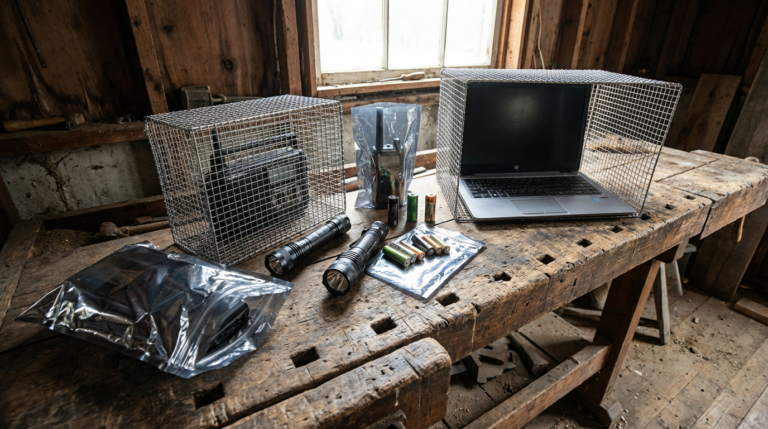
EMP preparedness attracts more mythology than almost any other prepper topic. On one side, you have people insisting that a nuclear EMP will instantly destroy every electronic device on Earth and return civilization to the 1800s overnight. On the other, you have dismissers who call EMP prep pure science fiction. The reality sits between those extremes — and understanding it precisely determines what is actually worth protecting, what methods work, and where to spend your money.
For a family of four focused on realistic preparedness, EMP protection does not require a bunker full of 1960s-era tube radios. It requires protecting a handful of critical communication and energy devices in a properly constructed Faraday enclosure, understanding the difference between an EMP event and a geomagnetic storm, and accepting that most of your household electronics are both more durable than the horror stories suggest and less worth protecting than a backup ham radio.
Understanding EMP: Three Components, Different Threats
A high-altitude nuclear electromagnetic pulse (HEMP) has three components. Each damages electronics differently:
E1 (The fast pulse): Lasts microseconds. Travels at nearly the speed of light. This is the component that destroys semiconductors — microchips, transistors, and circuit boards in modern electronics. E1 is induced in short antennas and conductors. This is what fries your phone, car computer, and radio.
E2 (The intermediate pulse): Similar to a lightning strike in timing and character. Standard lightning surge protectors can handle E2 — but E1 typically destroys those protectors first, leaving your equipment exposed to E2 without protection. E2 alone is not a primary concern; the problem is E1 disabling your protections before E2 arrives.
E3 (The slow pulse): Lasts minutes to hours. Similar to a geomagnetic storm (solar CME). This is what damages transformers in the power grid — the long-haul equipment that takes months to replace and is the primary reason major HEMP scenarios involve extended grid outages. E3 does not directly damage your household electronics, but it is responsible for the long-term infrastructure damage in severe EMP scenarios.
A nuclear weapon detonated at ground level or low altitude produces localized EMP effects, primarily near the blast zone. A weapon detonated at 30–400 km altitude (HEMP) produces an E1 pulse that can cover a large portion of a continent. These are fundamentally different scenarios requiring different concern levels. For most preppers, HEMP from a state actor is the relevant concern, not a tactical nuclear ground burst.
What Is Actually Vulnerable
Modern solid-state electronics are more sensitive to E1 than older vacuum tube designs. However, the real-world damage profile is more nuanced than “everything electronic dies.”
High vulnerability (protect these):
- Handheld radios (ham, GMRS, FRS)
- NOAA weather radios
- Satellite communicators
- Solar charge controllers and inverters
- Battery-operated flashlights with LED driver circuits
- Backup hard drives and USB drives with critical data
- Medical devices (hearing aids, insulin pumps, CPAP machines)
- Electronic ignition systems in vehicles (particularly newer models)
Moderate vulnerability (protect if you have space):
- Laptop and tablet computers
- Portable solar panels (the panels themselves are relatively robust; the charge controller is the vulnerable component)
- Battery banks and power stations
Lower priority (less likely to be permanently damaged or harder to harden):
- Large household appliances with simple electric motors (washing machines, refrigerators with mechanical thermostats)
- Non-electronic hand tools
- Older vehicles with minimal electronics (pre-1980 generally more robust)
How Faraday Cages Work
A Faraday cage is a conductive enclosure that shields its contents from external electromagnetic fields. The conductive shell intercepts and distributes the EMP energy around the exterior, preventing it from reaching the interior. The key physics:
- The cage must be fully continuous with no gaps larger than the wavelength of the EMP (E1 has very short wavelengths — gaps matter)
- The interior of the cage must be electrically isolated from the shell (direct contact between your device and the cage wall transfers the charge)
- More conductive material provides better shielding (solid steel is better than wire mesh, which is better than aluminum foil, though all provide some protection)
DIY Faraday Cages: What Actually Works
Method 1: Metal garbage can ($30–$50)
A galvanized steel trash can with a tight-fitting lid is the most popular DIY Faraday cage and provides legitimate protection for its cost. The key detail: you must electrically isolate the contents from the metal walls. Use cardboard boxes, foam padding, or plastic containers to keep devices from touching the metal directly.
The lid fit matters. Gaps reduce effectiveness. After closing the lid, run your hand around the seam — if you can feel significant gaps, use aluminum foil tape to seal them. Some people wrap the exterior of the can with two layers of heavy-duty aluminum foil for additional shielding.
The 20-gallon Behrens galvanized steel can ($35) is a good size for a family’s critical electronics kit. The lid fits tightly and it stores easily.
Method 2: Ammunition can ($15–$30)
Military surplus ammo cans provide excellent EMP shielding. They are built with gasket-sealed lids that create a near-continuous metal enclosure. They are also waterproof, compact, and stackable. The .50-caliber ammo can holds a NOAA radio, two handheld radios, a small battery bank, and a satellite communicator comfortably. This is what I use for our primary communications kit.
The rubber gasket in the lid provides some isolation between lid and body. Add a layer of cardboard inside to prevent device contact with the metal walls.
Method 3: Nested aluminum foil wrapping ($2–$5)
Triple-layering a device in heavy-duty aluminum foil provides reasonable E1 protection for individual items. This is the cheapest option and works for items like a spare NOAA radio or a backup phone. The limitation: foil has no structural integrity and can be punctured easily. Each layer of foil should be separated by a layer of paper or plastic (to maintain the isolation principle) before the next foil layer goes on.
| Method | Cost | Protection Level | Best For |
|---|---|---|---|
| Galvanized steel trash can | $35–$50 | Good | Full communications kit |
| Ammo can (.50 cal) | $20–$30 | Very good | Compact electronics kit |
| Triple-layer foil wrapping | $2–$5 | Moderate | Individual backup items |
| Mission Darkness bags | $30–$80 | Good to very good | Phones, tablets, radios |
Commercial EMP Protection Products
Mission Darkness Faraday Bags ($30–$80 depending on size): These are the best-tested consumer Faraday bags available. They use multiple layers of TitanRF shielding fabric tested to military MIL-STD-461G standards. A phone-sized bag ($30) protects a smartphone or small radio. A larger bag ($50–$60) handles a tablet or laptop. These are significantly better than the cheap “EMP protection bags” sold by less reputable vendors.
EMP Shield ($300–$400 for home unit): These are whole-home surge protection devices that claim to protect your electrical system from EMP. They are certified to various military standards and installed in your electrical panel. What they actually protect against is the E2 component (the lightning-like pulse) arriving through your home’s wiring. They do not protect against E1 (which comes through the air, not your wiring). They are a legitimate product, but their marketing often implies more complete protection than they provide. If you want grid-connected solar or generator systems to survive, this is worth considering for E2 protection, but it does not replace Faraday cages for critical items.
What to Store in Your EMP Protection Kit
For a family of four, I recommend protecting the following priority items:
- Backup NOAA weather radio (keep your primary in daily use; protect a backup in the Faraday cage)
- Backup pair of GMRS radios (with charger)
- Backup ham radio handheld (Baofeng UV-5R is cheap enough to keep as a spare; $30)
- Satellite communicator (Garmin inReach or SPOT X — these are expensive enough to protect)
- Backup solar charge controller (if you have a solar system; the controller is the most vulnerable component)
- Small battery bank (10,000–20,000 mAh)
- Backup hard drive or USB drives with critical documents (insurance, medical records, maps, manual, contact lists)
- Medical devices (backup batteries, replacement electronic components for critical medical equipment)
A .50 caliber ammo can lined with cardboard or foam holds: one NOAA radio, two GMRS radios with chargers, one ham handheld, one satellite communicator, two USB drives with critical documents, and a small battery bank. This entire kit costs under $200 for new equipment and fits in a waterproof, EMP-protected container the size of a shoebox. This is your communications lifeline if the grid goes dark.
Your Vehicle and EMP
Vehicle vulnerability to EMP is real but frequently exaggerated. Testing conducted by the EMP Commission found that most modern vehicles, when exposed to E1 levels in testing, experienced temporary disruptions (stalling, warning lights) rather than permanent damage — and many ran normally after restarting. The worst case from tested vehicles was that a few would not restart after exposure.
Practical implication: if you are driving when an EMP occurs, pull over safely. Try restarting. Many modern vehicles will restart and drive normally. Older vehicles with minimal electronics (pre-1985 especially) are generally more EMP-resistant.
You cannot practically harden a vehicle you drive daily. Focus your protection efforts on your backup communications equipment rather than on vehicle hardening.
Solar Panel Systems and EMP
If you have a grid-tied solar system, the charge controller and inverter are the most vulnerable components. The solar panels themselves (simple photovoltaic cells) are relatively robust. The electronics that manage the conversion and grid-tie connection are not.
For grid-tied systems, a whole-home EMP protection device provides some E2 protection. For off-grid systems, keep a spare charge controller in your Faraday cage. A basic MPPT charge controller for a small off-grid system costs $30–$60 and fits easily in an ammo can. A spare inverter is also worth protecting if your system uses one.
Common Mistakes in EMP Protection
- Devices touching the Faraday cage walls. The interior of a Faraday cage is at zero electric potential only if the contents are isolated from the cage itself. Devices touching the metal walls are not isolated. Always use cardboard, foam, or a plastic box as a liner.
- Gaps in the enclosure. Gaps larger than the wavelength of the EMP allow penetration. For E1, which has very short wavelengths, gaps matter significantly. Seal gaps with aluminum foil tape.
- Protecting equipment that does not need protection while ignoring what does. Many people wrap their smartphones in foil (which they will need anyway when the cell network is down) while leaving their backup ham radio sitting on a shelf. Prioritize communications equipment first.
- Using regular surge protectors and thinking they provide EMP protection. Standard surge protectors protect against voltage spikes from lightning or grid fluctuations. They are not designed for the ultra-fast E1 component of HEMP. The E1 pulse arrives before the protection activates.
- Confusing EMP protection with solar storm protection. A solar CME (geomagnetic storm) produces E3-like effects — it damages grid infrastructure but does not produce the E1 component that damages individual electronics. Your Faraday cage does not help against a solar storm, but your electronics at home are probably fine; it is the grid that is at risk.
- Over-investing in EMP protection at the expense of more likely threats. A major HEMP attack requires a state actor with a sophisticated weapons program and a specific intent to maximize infrastructure damage. A major hurricane, long-term power outage, or economic disruption is orders of magnitude more likely. Do not spend $2,000 on EMP protection before you have 90 days of food and water.
Frequently Asked Questions
Does wrapping a phone in aluminum foil protect it from EMP?
Single-layer foil provides minimal protection because the foil creates a ground plane but does not fully enclose the device in a continuous conductive shell. Triple-wrapped foil with paper or plastic isolation layers between each wrap provides moderate protection. For reliable protection, use a quality Faraday bag or place the foil-wrapped device inside a sealed metal container (ammo can, steel trash can).
Will my car work after an EMP?
Probably, based on actual test data from the EMP Commission. Most vehicles tested experienced temporary disruption but continued operating or restarted after the event. Pull over if your vehicle stalls, wait a moment, and try restarting. Older vehicles (pre-1985) with minimal electronics are generally more robust.
Do I need to protect my microwave, refrigerator, and other appliances?
Large appliances are lower priority than communications equipment. Refrigerators and washing machines have relatively simple electronic components compared to your ham radio or satellite communicator. They may be damaged or may not — but your primary concern should be maintaining communications and energy generation capability, not preserving home appliances.
How do I test if my Faraday cage works?
Place a powered cell phone inside your Faraday cage and try to call or text it. If the call goes to voicemail and texts do not deliver, the cage is attenuating radio frequency signals — a reasonable indicator it would provide EMP protection. This is not a perfect test (cell frequencies differ from EMP frequencies) but it is the most practical home verification method.
Should I store a backup generator inside a Faraday cage?
Generators are large, and Faraday cages work better for smaller items. Instead, focus on protecting the generator’s most vulnerable components: the voltage regulator and any digital controls. Small generators with minimal electronics (basic carburetor engines with simple magneto ignition) are more EMP-robust than modern fuel-injected generators with digital controls. Keep a backup voltage regulator in your Faraday cage if you have a generator you rely on.
The Bottom Line
EMP protection is a legitimate preparedness concern, not science fiction. But it is one specific threat among many, and it requires proportionate investment based on realistic probability assessment.
For a family of four, the practical action plan is: one .50 caliber ammo can ($25) lined with cardboard and stocked with backup communications equipment ($150–$200 total). That investment protects your family’s ability to receive information and communicate after any event that damages electronics — whether that is an EMP, a severe lightning strike on your home, a solar storm that takes down the grid, or a flood that destroys your primary equipment.
Build the ammo can kit. Store it somewhere cool and dry. Open it annually to check batteries and confirm everything is present. That is 95% of what most families need from an EMP preparedness standpoint — affordable, practical, and genuinely useful across multiple scenarios.
