
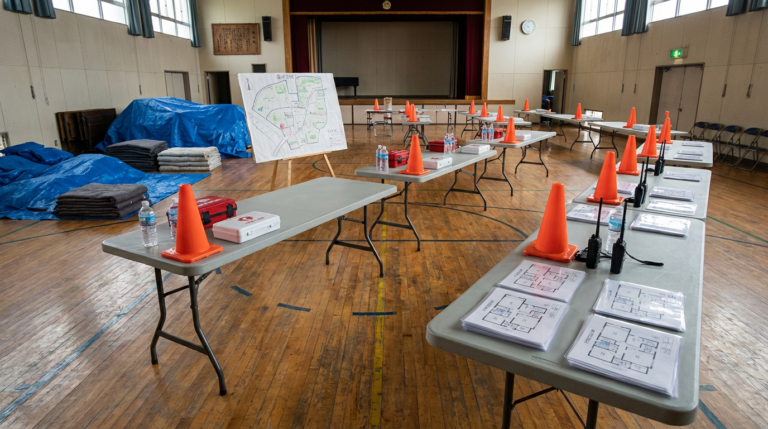
My family has a written nuclear emergency plan. We have supplies, KI tablets, a designated shelter room, a communication protocol, and laminated reference cards. For two years after I put that plan together, I thought we were prepared. Then we ran our first actual drill. Within 90 seconds, my 10-year-old had gone to the wrong room, my spouse could not find the emergency bag, and I had forgotten which GMRS channel we had designated for family check-ins. The plan existed. The practice did not. Those are not the same thing.
Emergency drills for nuclear scenarios feel awkward to set up and run. It is not like a fire drill where you walk to the front yard. It involves going to specific rooms, sealing doorways, locating supplies, and running through a communication sequence. But the families who execute correctly during real emergencies are almost universally the ones who have practiced. This guide covers exactly how to run nuclear emergency drills at the family and community level — including how to do it without traumatizing your children.
Why You Need More Than a Plan
A written emergency plan is a cognitive document. A drill converts it into procedural memory — the kind your brain accesses automatically under stress without requiring deliberate thought. Under acute fear, higher-order cognitive function is significantly impaired. You will not methodically consult a written plan while processing a real nuclear alert. You will do what you have practiced.
Research on emergency response consistently shows that people who have drilled specific procedures execute them significantly faster and more accurately under stress. That gap in performance — between people who have practiced and those who have not — is widest precisely when stakes are highest.
For most families, one comprehensive nuclear drill per year is appropriate. Supplement it with a brief 10-minute “walk-through” when you restock supplies (quarterly for most families). Each time you check expiration dates on KI and food, do a quick verbal review of the plan with your family. Familiarity maintained over time costs very little and pays significantly.
What a Family Nuclear Drill Covers
A complete family nuclear drill has five components. You can run them all in a single 45-minute session or break them across multiple shorter sessions for families with young children:
1. Alert recognition and initial response
The drill starts with an alert. Use your phone, a timer, or verbally announce “Nuclear emergency alert.” From that moment, time how long it takes each family member to reach their designated position. This is the most important metric — the time from alert to shelter.
2. Shelter-in-place setup
Practice sealing the shelter room. Your shelter should be the most interior room on the highest floor (or basement if you have one) — interior walls provide more shielding than exterior walls and windows. Practice with actual materials: plastic sheeting and tape. Time the setup. A family of four sealing a standard bedroom doorway and window should be able to do this in under 10 minutes.
3. Supply location and inventory
Each family member should be able to locate the emergency bag, the KI supply, the NOAA radio, and water without being directed. If someone cannot locate these items in 60 seconds of searching, relocate them or update your storage documentation.
4. Communication protocol test
Run through your communication sequence: turn on the NOAA radio, switch to your designated GMRS channel, attempt contact on the satellite communicator if you have one, and text or call your out-of-area contact. Confirm everyone knows the out-of-area contact’s number from memory (or from their wallet card).
5. Decision tree walkthrough
Walk verbally through the key decisions: Are we sheltering in place or evacuating? Where are the kids if they are at school? What do we do if one family member is not home? These decisions should have predetermined answers, not be made in the moment.
Making It Not Scary for Kids
The tone of a nuclear drill matters enormously. Children take emotional cues from adults. A drill run with anxiety, urgency, or disaster-framing will create anxiety in your children. A drill run as a practical competence-building exercise creates confidence.
How to frame the drill for different ages:
- Ages 4–7: “We are going to practice our safety plan, like we practice fire drills at school. When you hear the alarm, go to [room] and I will meet you there.” Focus only on their action (go to the room). Do not explain the nuclear part in detail. The action is what matters.
- Ages 8–12: Give them context and a role. “We have a plan for different emergencies including very big ones. Today we are practicing what happens if there is a nuclear emergency. Your job is [specific task]. Let’s see how fast we can do it.” Make it slightly competitive and praise execution, not speed alone.
- Ages 13+: Full briefing and real responsibility. Include them in the planning review before the drill. Assign them a leadership role for one of the five components. Debrief with them afterward on what could improve.
What to say after the drill: “That went well. Now we know what to do if something happens. We are ready.” Close the emotional loop with competence and readiness, not with continued focus on the threat.
Children who have a specific task in the drill are significantly less anxious than children who are passive observers. Even a 6-year-old can be responsible for getting their emergency backpack and the dog. An 8-year-old can be responsible for turning on the NOAA radio. Having a job provides agency, which is one of the most powerful buffers against fear.
The 45-Minute Family Drill: A Sample Script
Before the drill (10 minutes): Gather the family. Briefly review the plan: “Here is what we are practicing today. When the alarm goes off, everyone goes to the basement. Here is what each person does.” Review any changes since last year (new supplies, moved items, updated meeting points).
Drill execution (15 minutes):
- Sound the alert (phone alarm or verbal announcement).
- Everyone moves to the shelter room. Time it from alert to everyone inside.
- One person begins sealing the door and window with the plastic sheeting and tape kit.
- One person locates the emergency bag and confirms the KI supply is present.
- One person turns on the NOAA weather radio and finds the correct channel.
- Verify the GMRS radios are in the bag and powered. Do a quick radio check.
- Walk through the verbal decision tree: “Where are the kids? Who is not here? What do we do?”
Debrief (20 minutes): This is the most important part. Ask each family member what went smoothly and what was confusing or slow. Update the plan based on findings. Common issues from first drills: supplies in the wrong location, shelter room not being the most interior room, no one knowing the KI doses for their weight, communication protocol unclear.
Sample Drill Scenarios to Practice
After your first basic drill, add complexity on subsequent years by practicing these variations:
| Scenario | What It Tests | Key Question to Answer |
|---|---|---|
| Alert at 2 a.m. | Night response, sleep-disoriented execution | Does your NOAA radio wake the household? |
| One parent not home | Solo parent execution, child roles | Can the remaining parent execute all steps alone? |
| Child at school | Communication protocol, school shelter-in-place | Do you know your school’s procedure and contact? |
| Power is out | Battery backup, hand-crank radio | Can you operate all equipment without grid power? |
| Emergency bag is missing | Redundant supply locations | Do you have backup supplies in a second location? |
Coordinating with Schools
Your children spend roughly 7 hours a day at school. Knowing what your school does during a nuclear emergency is not optional preparedness — it is essential planning.
What to find out from your school:
- Does the school have a shelter-in-place protocol for radiological emergencies?
- Where would students be sheltered in the building?
- Does the school have KI supplies? (Schools within 10 miles of nuclear plants typically do; others may not)
- What is the school’s reunification procedure when parents cannot immediately retrieve children?
- Does the school have your out-of-area emergency contact information?
Most schools conduct lockdown and shelter-in-place drills regularly. Asking these questions of the school nurse or emergency coordinator is straightforward and typically welcomed. Knowing the answers lets you have accurate conversations with your children about what will happen if an event occurs while they are at school.
Building Community-Level Preparedness
Individual family preparedness is the foundation. Community coordination multiplies it. Even informal coordination with two or three neighbors significantly improves resilience:
Share information, not fear: Organize a brief neighborhood conversation about emergency preparedness. Frame it around general emergency readiness (fires, severe weather, blackouts) with nuclear scenarios as one element. This avoids triggering anxiety while building genuine preparedness.
Establish a neighborhood contact list: A shared contact list for immediate neighbors means you can check on elderly or vulnerable neighbors during a shelter-in-place event, share verified official information, and coordinate practical help.
CERT Training: Community Emergency Response Team (CERT) programs are free, government-sponsored training programs that teach basic emergency response skills including shelter-in-place procedures, first aid, and communication. They also build the community relationships that are independently predictive of better disaster outcomes. Find a local CERT program at ready.gov/cert.
ARES/RACES for ham radio operators: If any of your neighbors are licensed ham radio operators, connecting with local Amateur Radio Emergency Service (ARES) groups means you have access to a trained communication network during emergencies. These groups run regular drills that you can observe or participate in.
Community preparedness meetings organized around “what if the nuclear plant has an accident” tend to trigger anxiety and avoidance. Meetings organized around “how do we help each other during any major emergency” get better participation and build the same capabilities. Start broadly and the nuclear-specific components fall naturally into place.
Post-Drill Documentation
After each drill, spend 15 minutes on documentation. This is what makes next year’s drill better instead of repeating the same mistakes:
- Time from alert to shelter (benchmark against previous year)
- Issues found with supply location or accessibility
- Communication protocol gaps (who did not know the channel, number, or sequence)
- Shelter setup problems (tape quality, plastic sheeting placement, duration)
- Any questions that could not be answered (kids’ school protocol, neighbor contacts, etc.)
- Actions to take before next drill (restock, move items, contact school, etc.)
This becomes your annual preparedness review document. Over three or four years of drills, your family’s execution time shortens dramatically and the gaps shrink to minor refinements.
Common Mistakes in Nuclear Emergency Drills
- Only doing a tabletop review, never a physical drill. Discussing the plan is not the same as doing it. The value of a drill comes from physical execution under time pressure, not from conversation.
- Not timing the drill. Time from alert to shelter is your key metric. Without measuring it, you have no way to know if you are improving or where the bottlenecks are.
- Skipping the debrief. The 20-minute debrief after the drill is where the learning happens. Families that skip it miss most of the value.
- Running drills with too much emotional loading. Framing the drill as “practicing for when we might die” creates anxiety that makes execution worse. Frame it as skill-building. You are getting good at something, not practicing your own death.
- Never varying the scenario. A basic drill is the starting point. The 2 a.m. drill and the “one parent not home” drill reveal gaps that the standard drill cannot.
- Not involving children meaningfully. Children who are bored passengers in a drill will not remember what to do. Children who have real roles and feel effective will.
Frequently Asked Questions
How do I start a nuclear drill without scaring my young children?
Frame it as a safety skill, like swimming lessons or fire drills. “We are learning what to do if there is a big emergency. It is like a fire drill at school — we practice so we know what to do.” Emphasize the competence and safety of the family rather than the nature of the threat. Children under 8 generally do not need a detailed explanation — they need a clear, simple action and a confident parent.
How long should a nuclear emergency drill take?
A complete family drill including debrief takes 45 minutes to one hour. Your actual execution time — from alert to fully sheltered and set up — should be under 15 minutes for most families. Track the execution time as a benchmark across years.
Should I contact my neighbors about doing drills together?
For direct immediate neighbors, a casual conversation about general emergency preparedness is appropriate and usually welcomed. Full community drills are more involved and are typically organized through formal channels like local emergency management offices or CERT programs. Start with your family, then expand to immediate neighbors, then consider community-level involvement.
Do we need to practice decontamination in the drill?
Yes, at least once. A “dry run” of the decontamination procedure — where you talk through and physically demonstrate (without actual contamination) the steps of clothing removal, bagging, and shower protocol — is valuable, especially for children who will find the process disorienting under stress. You do not need to actually bag clothes, but walking through the physical motions while talking through each step creates the procedural memory you want.
What if I live near a nuclear power plant?
You may have additional resources available to you. Many states distribute KI tablets free to residents within 10 miles of nuclear plants. Local emergency management offices near plants also run public preparedness programs and drills that you can participate in. Contact your county emergency management office to find out what is available and whether your address qualifies for free KI distribution.
The Bottom Line
A nuclear emergency drill is not about fear. It is about converting your paper plan into physical capability. The 45 minutes you spend running a drill once a year is the difference between a family that freezes and a family that acts.
Run your first drill this year. Time it. Debrief it. Fix the gaps. Run it again next year. By the third year, your family’s response will be automatic, calm, and effective — exactly the outcome preparedness is supposed to produce.
The families I know who have drilled consistently report something that surprised them: after a few years, the kids are not scared of the topic. They are confident about it. They know what to do. That confidence — earned through practice — is exactly what good preparedness looks like.
